Fifteen years ago, a venture capitalist predicted that software would eat the world. He was wrong about only one thing: the speed. The meal is almost finished, and the organisations still arguing about whether they are a technology company are the ones already being digested. A point of view for chief executives, boards and leadership teams planning the next five years.
At a glance
- The debate is over. Every industry is now a technology industry. The question is no longer whether to adopt technology, but whether a business will shape its own transformation or have it shaped by competitors, customers and regulators.
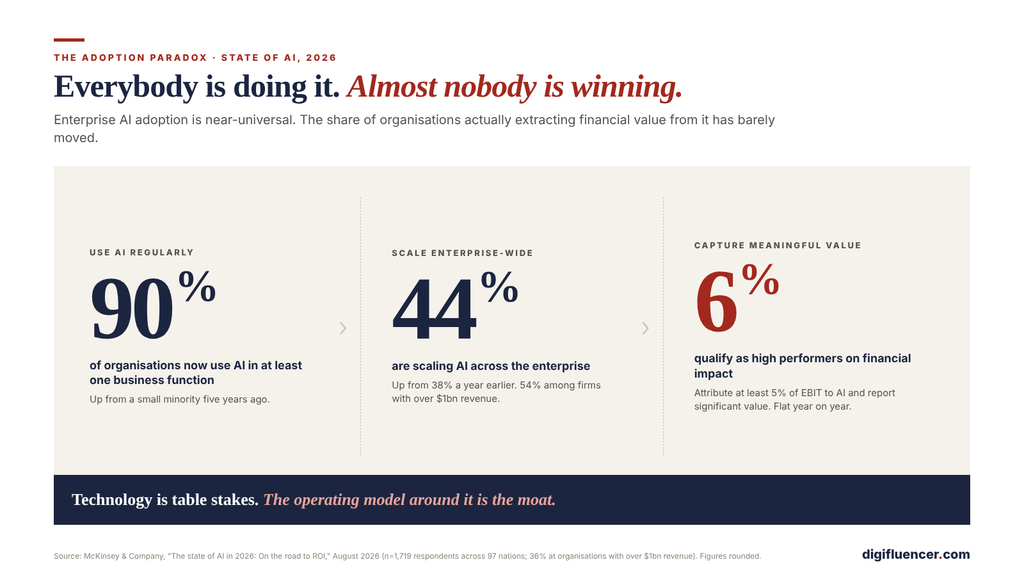
- The adoption paradox. Roughly 90% of organisations now use AI regularly in at least one business function, and 44% are scaling it enterprise-wide, yet only about 6% qualify as high performers that extract meaningful financial value (McKinsey, August 2026). Adoption is widespread. Advantage is rare.
- The threat has moved. The risk to incumbents is no longer a competitor with a better product. It is a competitor with a better technology operating model. A legacy manufacturer competes with a software platform that happens to make things. A bank competes with a data business that happens to hold deposits. A consultancy competes with an AI-first firm that bills for outcomes rather than hours.
- Our guidance. Winning organisations do not treat technology as a capex line. They treat it as a business model choice, governed at board level, resourced like a core product, and secured from the first line of code.
We set out the five industry patterns reshaping competition, a four-stage adoption framework, and the questions every CEO should be able to answer before approving the next technology investment.
The prophecy, and the part that has not yet been priced in
In August 2011, Marc Andreessen wrote that software was eating the world. He named a handful of industries, music, film, retail, telecoms, that had already been remade by software companies dressed up as something else. The list was short because, in 2011, it had to be.
In 2026, the list is every list.
The world’s largest taxi company owns no cars. The largest retailer sells nothing in a store. The fastest-growing lender to small businesses is a payments platform. The company that disrupted hospitality owns no hotels. The organisation closest to your customer in almost every category is now, in some meaningful sense, a software business.
That part of the prophecy is widely accepted. The part most boards have not yet priced in is the corollary. If every industry is now a technology industry, then every incumbent is now a technology competitor. You do not get to choose whether your business is measured on its technology. You only get to choose whether you build the technology that defines the measurement, or inherit the technology someone else built for a different market.
For most CEOs, the honest answer is that they are still inheriting.
The adoption paradox: everybody is doing it, almost nobody is winning
Spend five minutes at any industry conference and you will hear the same words. Transformation. Platform. AI-first. Agentic. Cloud-native. The language of technology has reached the chief executive’s office. The results, for most, have not.
The most careful survey of the enterprise AI landscape found that 90% of organisations now use AI regularly in at least one business function, and 44% are scaling it enterprise-wide, up from 38% a year earlier (McKinsey, August 2026). Yet the share seeing material EBIT impact has barely moved, and only about 6% of respondents qualify as high performers who attribute at least 5% of earnings to AI and report significant value from it.
The pattern is consistent across every enterprise technology wave of the past thirty years. Cloud. Mobile. Data. CRM. Automation. Adoption has been near-universal. Advantage has not. Technology is table stakes. The operating model around it is the moat.
This is the uncomfortable truth behind the dashboards. The companies that win are not the ones with more tools. They are the ones with the right operating model, the right technical foundation, and the discipline to connect both to business outcomes. Everyone else is subsidising the winners’ learning curve.
Five industries, five patterns
The way technology reshapes an industry depends on the industry’s own physics. The patterns, however, rhyme. Five of them are reshaping competition faster than most boardrooms are adapting.
1. Manufacturing: from the physical to the cyber-physical
For a century, manufacturing was a story about machines on a shop floor. The last decade has quietly rewritten it. The machines are now instrumented. The shop floor is now a data stream. The product itself, in categories as diverse as cars, tractors, lifts and medical devices, is now connected, updatable and observable.
Advanced manufacturers scale AI agents in supply chain, inventory and process optimisation more than in any other area (McKinsey, 2026). The leaders compete on two moats their competitors cannot see: the data they collect from installed products, and the speed with which they can turn that data into software updates, new services and better next-generation designs.
The uncomfortable implication is that a maker of physical products is now being judged on the quality of its software, its APIs and its cybersecurity posture. A connected product that fails to update is a liability; one that is breached is a headline. We have written about why website and product security are now board-level issues, and the principles that apply to a corporate website apply, with higher stakes, to any connected physical product.
What leaders should do now. Treat the connected product as the real product. Fund the software and data capability as if it were manufacturing’s R&D line, because it is.
2. Retail: the shelf has moved to the algorithm
Retail was the first industry to concede that it had become a technology industry, and it is still the clearest illustration of what that means. In 2011 the question was whether to open an e-commerce channel. In 2027 the question is whether a retailer owns the stack that decides which product a customer sees, at what price, in what context, on which surface, and whether the customer’s AI assistant lets the brand appear at all.
McKinsey finds that consumer goods and retail companies most often scale AI agents in marketing and sales (McKinsey, 2026). But the deeper shift is on the discovery side. Google’s AI summaries have cut click-throughs on organic results substantially, and a growing share of shoppers begin their journey inside a conversational AI tool rather than a search bar. We set out the implications for brands in our complete guide to SEO strategy and, for Australian fashion specifically, in our growth playbook.
The retailers that win from here own three things that cannot be rented: a first-party data relationship with the customer, a fast and reliable digital storefront, and the structured content that makes them discoverable in both search and AI answers.
What leaders should do now. Treat the storefront, whether a website, an app or a marketplace listing, as critical national infrastructure for the brand. A slow or compromised storefront is now a measurable loss of market share, as we set out in signs your website is costing you customers.
3. Healthcare: the data-rich, insight-poor industry finally catches up
Healthcare has long produced more data per decision than almost any other industry and used less of it. That is changing fast. McKinsey’s survey finds that pharmaceuticals and medical products firms are among the most likely to expect higher AI investment in the next year, alongside banking and insurance (McKinsey, 2026).
The transformation is happening in three waves. Clinical operations are being rebuilt around AI-assisted documentation, scheduling and triage. Drug discovery is being compressed from decades to years by generative models. And the patient relationship, long mediated by paper and phones, is being rebuilt around secure digital front doors.
Every one of those waves breaks on the same rock: trust. Healthcare has no tolerance for a hallucinating model, an exposed record or an unaccountable algorithm. Our briefing on agentic AI security sets out the controls that regulated industries, healthcare most of all, now need in place before an AI system is allowed near a patient.
What leaders should do now. Invest first in the digital foundations, identity, consent, interoperability and security, that make everything else safe to deploy. The organisations skipping that step will be forced back to it by the regulator.
4. Professional services: from billable hours to productised expertise
Professional services, law, accounting, consulting, agencies, were supposed to be hard to disrupt. The product was judgement. The moat was reputation. The economics rewarded scarcity of expertise.
That model is under pressure in a way it has never been. Generative AI compresses research, drafting and analysis from days to minutes. Clients have noticed. The firms winning share are not the ones that resist, nor the ones that hand everything to a model. They are the ones productising their expertise: packaging what their senior people know into tools, platforms and offers that scale beyond the hours their senior people can personally work.
This matters most for firms whose revenue depends on hours sold. The arithmetic is unforgiving. If a firm’s junior work is now done faster and cheaper by a machine, the firm has two options. Lower its prices, or raise the altitude of its output. The first is a race to zero. The second requires technology, not just talent.
For a professional services firm, this is also where marketing and technology converge. Our guide to the website for a consulting business sets out the modern expectations of buyers: 67% of B2B buyers now prefer a rep-free experience before they speak to anyone. The website and the content behind it are increasingly the first, and sometimes only, product a prospective client meets.
What leaders should do now. Decide which of your firm’s work is productisable. Build or commission the tools that scale that work. And treat your digital presence as the senior partner who is on duty twenty-four hours a day, because it is.
5. Financial services: when every bank is a data business
Banking and insurance have always been, at some level, information businesses with a licence to take risk. In 2027, the information side of that sentence is the only one that is growing in strategic weight. McKinsey finds that banking and insurance are among the industries most likely to increase AI investment in the next year (McKinsey, 2026).
The competitive pressure is coming from two directions. Fintechs and platforms continue to pick off individual products with better software. And established incumbents are being judged, by regulators and by shareholders, on the quality of their data, models and controls. Agentic AI is beginning to appear in fraud detection, underwriting, compliance review and customer service, bringing with it a new category of risk that most governance frameworks were not built for.
A bank that wins from here will do three things that most do not yet do well. It will treat its data estate as a strategic asset with product-grade governance. It will build and buy AI with the same rigour it applies to credit models. And it will secure its digital surface, from the public website to the agent-accessible API, as if its licence depended on it, because it increasingly does.
What leaders should do now. Appoint a single accountable owner for the AI operating model, not just for AI projects. Treat the website and customer channels as regulated surfaces, with the same posture as a core banking system.
The adoption curve: a four-stage maturity model
Across industries, the organisations we work with fall into four recognisable stages of technology adoption. Honest self-assessment is the first act of strategy.
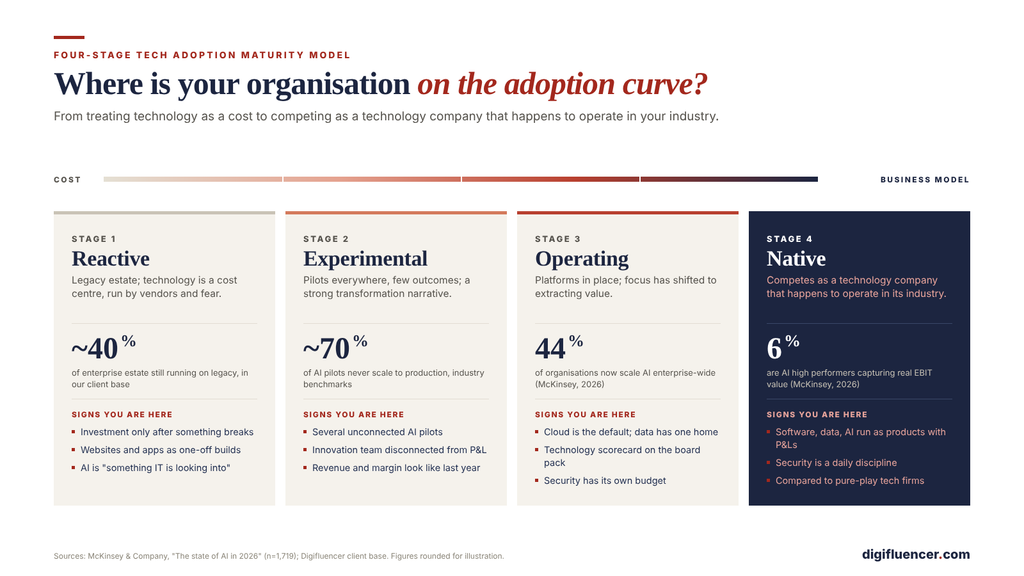
Stage 1: Reactive
Technology is a cost centre. The estate is a patchwork of legacy systems held together by consultants and fear. Investment happens when something breaks, is audited or embarrasses someone. Board reporting is dominated by uptime and spend.
Signs you are here: decisions about technology are delegated to vendors. AI is “something IT is looking into.” Website and app projects are quoted as one-off builds, not products.
Stage 2: Experimental
The organisation knows it needs to change. Pilots proliferate. There is a small innovation team. The head of marketing has an AI pilot. The CFO has an AI pilot. The customer-service director has an AI pilot. Few of them connect. Fewer still survive a board review a year later.
Signs you are here: a strong narrative about transformation, but revenue, margin and customer outcomes look much like last year’s.
Stage 3: Operating
The platforms are in place. Cloud is the default. Data has a single, if imperfect, home. AI is embedded in several core processes. Technology leaders are at the executive table and in the boardroom. The focus has shifted from “do we have it?” to “are we getting the value out of it?”
Signs you are here: board packs include a technology scorecard. Projects are evaluated on business outcomes. Security and resilience have budgets of their own.
Stage 4: Native
The organisation competes as a technology company that happens to operate in its industry. Software, data and AI are first-class products with product managers, roadmaps and P&Ls. Customer-facing surfaces and internal operations share a platform. Security and compliance are a daily discipline, not a quarterly fire drill.
Signs you are here: your industry’s analysts compare your software to pure-play technology firms, not only to peers in your sector. You are hired away from, as well as into.
The journey from Stage 1 to Stage 4 is not linear, and it cannot be shortcut by a reorganisation or a logo change. It is the result of ten to twenty consistent decisions a year, made at board level, across technology, operating model, talent and capital allocation.
Where to start: a framework for the next twelve months
A CEO reading this far may be nodding, and then quietly wondering where, in practice, to begin. We use a five-part framework with the leadership teams we advise. It is deliberately ordered.
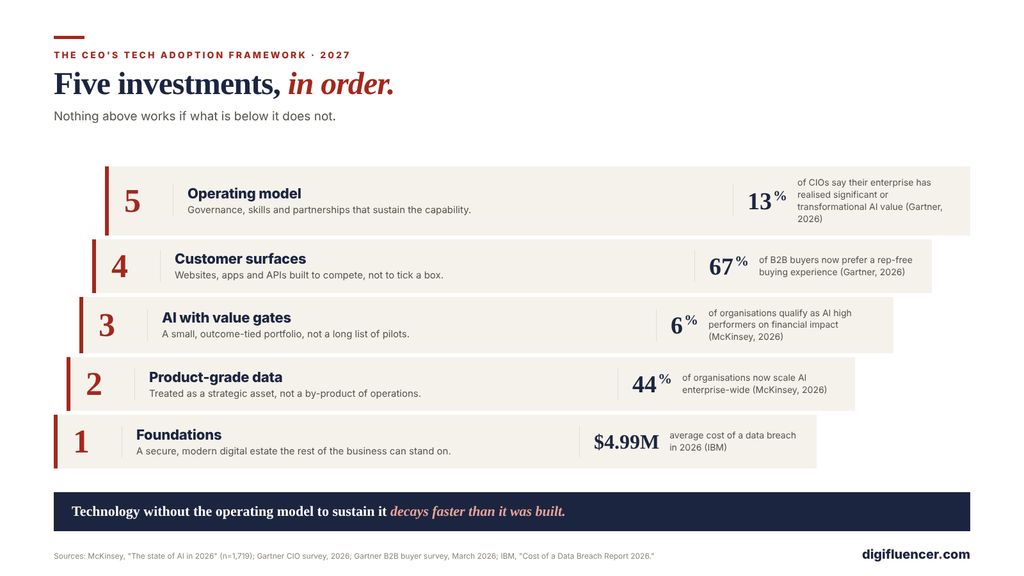
1. Foundations: a secure, modern digital estate
Nothing further works if this does not. A technology-defensible business needs a modern cloud estate, a well-maintained web presence, a defensible identity and access model, and a security posture equal to the value it carries. For many organisations, the single biggest unit-economics unlock of the next twelve months is simply retiring legacy systems that no one wants to touch. Our point of view on this is in legacy modernisation, and the resilience case for website investment is in website maintenance cost.
2. Product-grade data
Data is still the asset most organisations say is strategic and treat like a by-product. Product-grade data means someone owns it, someone is accountable for its quality, and it is instrumented for the decisions and models the business actually wants to run. Without this, every AI investment is a prototype.
3. AI with value gates
The shortest path to disappointment is a long list of AI pilots with no shared definition of success. We recommend a portfolio approach: a small number of use cases with clear hypotheses, named executive owners, measurable outcomes and pre-agreed stop or scale decisions. The organisations that get value from AI are not those that try everything. They are those that finish things.
4. Customer surfaces built to compete
The website, the app, the marketplace listing, the search result, the AI answer and, increasingly, the agent-accessible API. These are now the places the brand is judged. Treat them with the investment, measurement and ownership of a product, not a project. For most B2B companies, this is also where lead quality is won or lost long before sales gets involved.
5. Operating model: governance, skills and partnerships
Technology without the operating model to sustain it decays faster than it was built. Leaders should decide which capabilities must be in-house (usually data, security, product and the core architecture) and which are better delivered by a partner whose depth would take years to build. In our experience, the most durable models combine a lean internal team with a small number of senior, long-term partners who can flex across design, engineering, cybersecurity and growth. Our own services are structured around precisely that combination.
Five mistakes CEOs make when adopting technology
The same patterns recur in boardroom after boardroom. If you recognise more than two of these, your organisation is probably at Stage 2.
- Treating technology as a project, not a capability. Projects end. Capabilities compound. The spend that creates lasting advantage is funded like a product, not approved like a procurement.
- Delegating the technology strategy. A CEO who cannot articulate the business’s technology strategy in two minutes is operating on someone else’s. Usually the systems integrator’s.
- Mistaking tools for transformation. Buying a new platform without changing the operating model around it is the enterprise equivalent of installing a new kitchen and continuing to eat out.
- Under-investing in the first line of defence. The modern business’s most exposed asset is its digital surface. In a landscape where the average cost of a data breach has reached $4.99 million (IBM, 2026), under-funding security is not thrift. It is a bet against a certainty. Our briefing on website security for business owners sets out what a defensible posture looks like.
- Confusing adoption with advantage. Many organisations will adopt AI. Few will capture value from it. The difference is the operating model, not the tooling.
Questions every board should be able to answer
Before approving the next technology investment, a CEO and board should be able to answer each of these without turning to the CIO.
- Where are we on the maturity curve, honestly, by business unit?
- What is our technology operating model, and who owns it?
- What is the one capability, if we built it, that would most change our competitive position in three years?
- Which of our customer-facing surfaces, websites, apps, APIs, marketplace listings, are we behind on, and what is that costing us today?
- What is our data strategy, and who is accountable for data quality as a product?
- How much of our AI effort is tied to measurable business outcomes with named owners?
- What is our security and resilience posture, and when was it last independently tested?
- Which of our systems, if they failed for a week, would materially damage the business?
- What share of our technology spend is maintaining the past, and what share is building the future?
- Who, in our leadership team, is personally accountable for closing the gap between our ambition and our reality?
If several of these are hard to answer, the next investment should be the visibility to answer them. That is almost always a better use of capital than the shiny initiative it would otherwise fund.
What good partnership looks like
The myth of transformation is that it is done by one visionary leader with a napkin. The reality is that it is done by a small group of people who will not let go of a problem, supported by partners with scars.
The right technology partner, in our experience, does three things. They work alongside the business, not in parallel to it. They own outcomes, not deliverables. And they bring the full stack, design, engineering, security, data, AI and growth, because that is how real businesses are built and how real customers meet them.
The wrong partner sells hours, finishes the statement of work, and leaves the organisation with a slide deck and a bill. There are many of both in the market. Choose carefully.
Where is your organisation on the maturity curve? We offer a complimentary Tech Adoption Readiness Review for CEOs and boards: a confidential two-hour session that places your business on the four-stage model, identifies the two investments most likely to move you up it, and names the risks that could set you back. Request your review →
Frequently asked questions
Q: Is this really true for every industry, or only the ones that look like tech?
A: Every industry. The pace varies. Media and retail moved first. Financial services and healthcare are mid-way through. Construction, agriculture, mining and government are later in the curve but moving faster than most of their incumbents recognise. The question is not whether, but when, and whether your organisation leads or follows.
Q: Our business is small. Does this apply to us?
A: Even more so. Small and mid-sized businesses have fewer legacy systems to unwind and are often closer to the customer. The best-run SMEs can reach Stage 3 faster than most large enterprises, and compete with much larger rivals on the strength of a modern digital operating model.
Q: We have adopted AI. Isn’t that the hard part?
A: Adopting AI is not the hard part. Only about 6% of organisations qualify as high performers in extracting financial value from it (McKinsey, 2026). The hard part is the operating model, data foundations and measurement discipline that convert pilots into results.
Q: Do we need to build everything in-house?
A: No, and most organisations should not. In our experience the strongest operating models are a lean internal team covering strategy, architecture, data and security, combined with a small number of senior, long-term partners for design, engineering, cybersecurity and growth. The in-house question is which capabilities are too strategic to outsource, not whether to partner at all.
Q: How long does this transformation take?
A: The visible results, better conversion, faster releases, lower incidents, can appear in a quarter. Moving one full stage up the maturity curve typically takes between 18 and 36 months of consistent leadership attention. Organisations that treat it as a one-year programme usually regress; those that treat it as a permanent capability keep compounding.
Q: What is the single biggest mistake to avoid?
A: Delegating the technology strategy. The next five years will be defined by decisions a CEO cannot sub-contract: how the business competes on technology, what it owns and what it rents, and how it is governed. Everything else follows from those.
The bottom line
The organisations that will lead their industries in 2030 are already making the decisions that place them there. They are not the ones with the loudest transformation narrative. They are the ones quietly moving up the maturity curve, one honest conversation at a time, until the industry wakes up to the realisation that a competitor they used to think of as a bank, a retailer, a manufacturer or a consultancy is in fact, now, a technology company that happens to operate in their space.
Every industry is now a technology industry. The only question left for a CEO is which kind of technology company you intend to be.
Digifluencer helps leaders turn their organisations into the technology companies their industries now demand. Our design, engineering, cybersecurity, AI engineering and growth teams work together across strategy, build and run, so that technology, security and marketing pull in the same direction and every investment ties to a business outcome. We work with boards and executive teams across manufacturing, retail, healthcare, professional services, financial services and the public sector.
If this article has prompted a conversation you would like to have with people who have been through it before, we would be glad to be useful. In a Tech Adoption Readiness Review, we place your business on the four-stage maturity model, identify the two investments most likely to move you up it, and name the risks that could set you back. There is no obligation, and you keep the findings whatever you decide.
Book your Tech Adoption Readiness Review →
Sources
- McKinsey & Company, “The state of AI in 2026: On the road to ROI,” August 2026 (n=1,719 participants across 97 nations; 36% at organisations with over $1 billion revenue). https://www.mckinsey.com/capabilities/quantumblack/our-insights/the-state-of-ai
- IBM, “Cost of a Data Breach Report 2026,” as reported by eSecurity Planet. https://www.esecurityplanet.com/cybersecurity/ibm-2026-cost-of-a-data-breach-report-key-findings/
- Gartner, “Gartner Sales Survey Finds 67 Percent of B2B Buyers Prefer a Rep-Free Experience,” 9 March 2026. https://www.gartner.com/en/newsroom/press-releases/2026-03-09-gartner-sales-survey-finds-67-percent-of-b2b-buyers-prefer-a-rep-free-experience
- Marc Andreessen, “Why Software Is Eating the World,” Andreessen Horowitz, 20 August 2011. https://a16z.com/why-software-is-eating-the-world/