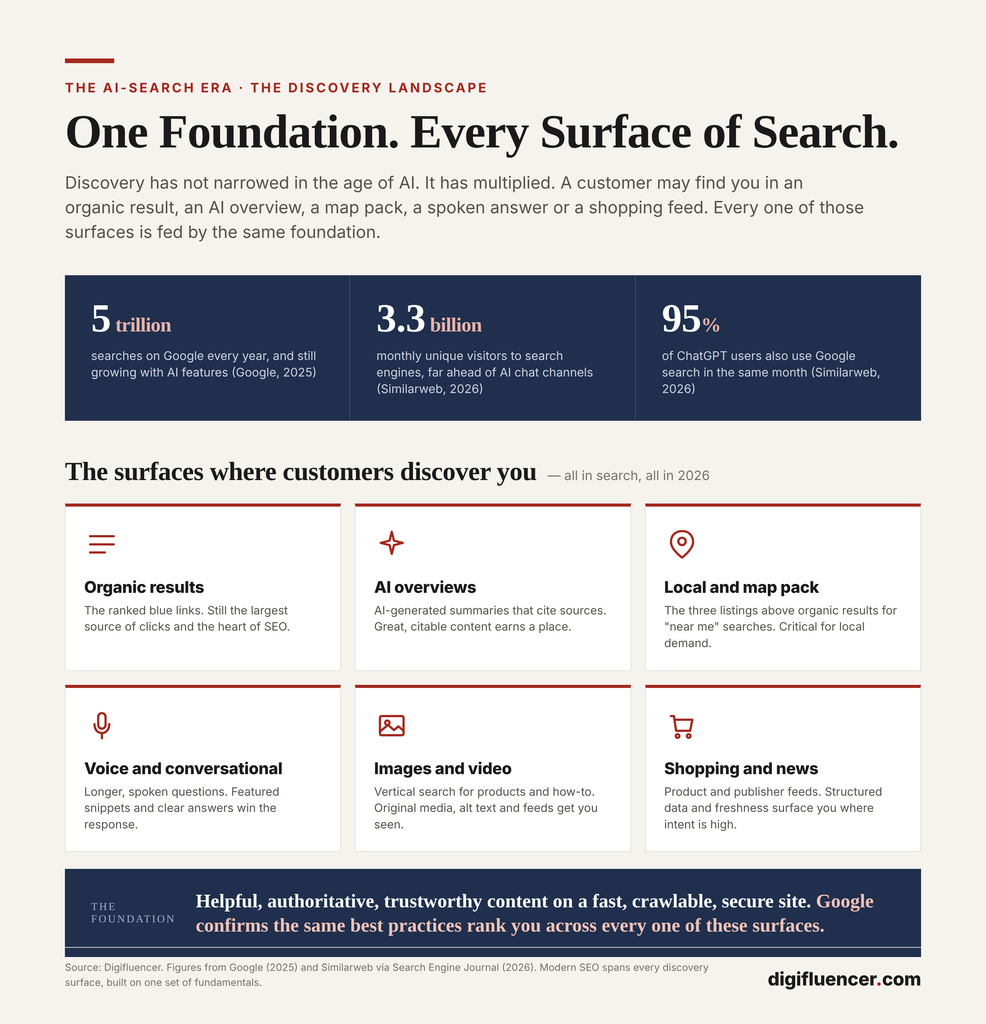
Strategy and Technology: Artificial intelligence is changing how people discover information. But the organisations that lead in the AI era are not abandoning search. They are deepening their mastery of it. The rules of SEO have not changed. The rewards have only grown higher. Search engine optimisation has moved from a tactical marketing activity to a strategic imperative. More than five trillion searches happen every year on Google alone. Search drives 3.3 billion monthly unique visitors, far exceeding generative AI channels.
Google Search’s revenues reached $63.27 billion in the second quarter of 2026, growing at 17% year-on-year. The organisations winning in today’s market are those that control how they are discovered in search. This guide covers the foundations of modern SEO, the framework for building a search strategy that grows your business, how to navigate the shift to AI-powered search results, the common mistakes that waste budget, and the investment case for SEO as a driver of sustainable growth.
Why Search Still Matters
Business leaders often ask a version of the same question: if AI chatbots now provide instant answers, why should we invest in search engine optimisation?
The answer lies in where customers actually go to find information.
In July 2026, Similarweb reported that search engines received 3.3 billion monthly unique visitors across Google and its competitors. Generative AI platforms, by contrast, received 9.5 billion monthly visits in total—but when examined closely, more than 95% of people using ChatGPT also use Google search in the same month. Search is the place people go first. AI supplements that journey; it does not replace it.
Google processes more than five trillion searches every year. Alphabet’s search business generated $63.27 billion in the second quarter of 2026, a 17% increase year-on-year. The company specifically noted that “AI features continue to drive growth in overall queries.” This is not the behaviour of a dying channel. It is the behaviour of a market that is deepening, not shrinking.
Five trillion searches a year. 3.3 billion monthly unique visitors. That is where your customers are looking.
The shift to AI-powered search results has raised legitimate questions about how search results are displayed and how visitors click through to websites. Research by Pew (July 2025) found that pages appearing in AI Overviews saw an 8% click-through rate compared to 16% for traditional search results. But this finding is often misinterpreted. AI Overviews do not replace traditional results; they sit above them. A Pew study found that click rates inside the summary were minimal (roughly 1%), but 95% of search sessions still included traditional links below the overview. For pages that appear both in the overview and in regular results, visibility increased, not decreased.
The real shift is not the death of SEO. It is the broadening of what SEO means. Organisations must now be discoverable across search results, AI features, local discovery, voice search and vertical search platforms. The foundation remains the same. The surface has expanded.
Six Reasons SEO Is the Backbone of Digital Marketing
1. Search Is How Customers Find You When They Need You Most
Unlike advertising, where you interrupt someone’s attention and hope they are interested, search puts you in front of customers who are actively looking for what you offer. A person typing “commercial property management software” is a customer signal. A person searching “how to cut water costs in manufacturing” is a potential buyer who has already identified a problem. These are high-intent moments. A business that ranks for these queries owns a direct line to customers who are ready to buy.
2. Search Traffic Compounds Over Time, Unlike Paid Channels
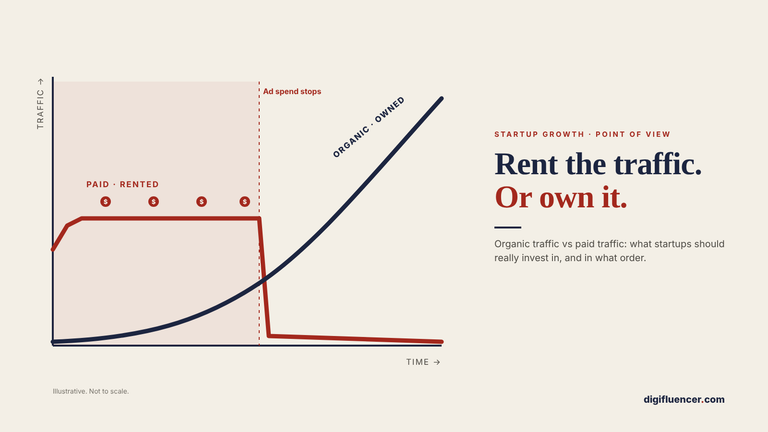
Paid advertising stops the moment you stop paying. The visitor evaporates. Search traffic, by contrast, builds on itself. Each month that a page ranks for valuable queries, it attracts visitors. Those pages become assets. Over three to five years, a business with a mature SEO programme attracts far more qualified visitors per pound spent than paid advertising alone can sustain. This compounds across the site: strong search visibility becomes a self-reinforcing advantage.
3. Search Carries Trust That Paid Channels Cannot Match
A study of search behaviour shows that searchers distinguish between paid ads and organic results, and they trust organic results more. When a customer finds you through a Google search (not a paid ad), they perceive your business as more established and trustworthy than a competitor who appears only in paid placements. This is not sentiment; it is measurable in how customers interact with your site. Visibility in organic search is a credibility signal.
4. Search Gives You Visibility Into What Customers Actually Want
Search queries are the unfiltered voice of your market. Every search is a question customers are asking, a problem they are trying to solve, a product they are trying to find. Google processes five trillion queries a year. Analysing the queries that bring visitors to your site, and the gaps where competitors rank and you do not, tells you exactly what the market wants. This intelligence is invaluable for product development, content strategy and competitive positioning. Paid channels do not offer this insight.
5. Search Traffic Scales Efficiently With Business Growth
As your organisation grows, search traffic grows with it. More pages, more topics, more authority, more visibility. The cost to acquire a search visitor decreases over time as your technical foundation strengthens and your authority increases. Paid channels often see the opposite: as the market becomes more competitive, cost per click rises. SEO is the only channel where efficiency improves as you scale.
6. Search Is Resilient to Market Disruption
Platforms come and go. Advertising platforms change their policies and costs. Organic search has survived every major technological shift of the past twenty-five years: the mobile revolution, the rise of AI, the growth of social media, the emergence of voice search. Search has adapted, deepened and persisted. A business that ranks for the searches its customers perform has a moat that is far more durable than one relying solely on paid channels or social platforms.
How Search Works in 2026
To excel at SEO, a business leader does not need to understand every algorithm update. But understanding how search engines work is essential to strategy.
The Three Pillars of Search: Crawl, Index, Rank
Crawl. Search engines send out automated bots that follow links across the internet, reading the content on each page. These bots (called spiders or crawlers) are looking for new pages, changes to existing pages, and links to pages elsewhere on the web. If your website is not linked to, crawlers will not find you. If your site’s technical foundation makes it hard to crawl (slow loading, broken links, missing sitemaps), search engines will crawl you less frequently.
Index. Once a crawler reads a page, search engines add it to their index. This is a vast database of hundreds of billions of pages. Indexing is not guaranteed. A page must be crawlable and of sufficient quality to be indexed. If your page is blocked (through file permissions or a robots.txt directive), it will not be indexed. If Google deems it low quality or a duplicate of another page, it may not index it.
Rank. When a person searches, Google runs an algorithm across its index to find the most relevant and highest-quality results for that query. This ranking algorithm considers hundreds of factors: relevance of the content, authority of the site, user experience, page speed, mobile-friendliness, freshness of content and many others. The goal is to show the most useful result first.
These three steps are fundamental. They have not changed. What has changed is the sophistication of the ranking algorithm and the number of factors Google considers.
The Rise of Learning Models and E-E-A-T
In March 2023, Google introduced helpful content guidance based on machine learning. By 2026, Google’s ranking system relies heavily on learning models trained on patterns of what humans find helpful. The company emphasises E-E-A-T: Experience, Expertise, Authoritativeness and Trustworthiness.
- Experience. Do you have real, lived experience with what you are writing about? A product review from someone who has used the product ranks higher than one from someone who has not.
- Expertise. Are you knowledgeable about the subject? Medical content about rare diseases should come from a doctor, not a generalist writer.
- Authoritativeness. Is your organisation known as a leader in this field? Do other authoritative sources link to you? Does the media cover you?
- Trustworthiness. Is your site secure, transparent about authorship and reliable?
These are not technical factors. They are signals of quality that Google tries to identify through data (links, citations, mentions, author credentials, site structure) but ultimately aims to reward genuine quality.
The Four Pillars of Modern SEO
Modern SEO rests on four interconnected pillars. Strength in all four is necessary to rank and scale visibility.
Pillar 1: Technical SEO
What it covers: The foundation of your website—how it loads, how search engines can crawl it, whether it is mobile-friendly, whether it is secure, and whether your site structure helps search engines understand your content.
Why it matters: A website can have brilliant content, but if it loads slowly or is not crawlable, search engines will not rank it highly. Technical SEO is the entry fee to the game.
Key elements:
- Page speed. Pages that load in under two seconds rank higher. Mobile speed is critical.
- Mobile-first indexing. Google indexes the mobile version of your site first, so if your mobile experience is poor, your rankings suffer.
- Site structure and navigation. A logical hierarchy helps search engines understand your content and lets users find what they need.
- XML sitemaps and robots.txt. These files tell search engines which pages to crawl and index.
- HTTPS and security. Google ranks secure sites higher.
- Structured data (schema markup). This helps search engines understand what your content is about. Schema for reviews, products, articles and organisations helps Google show richer results.
Investment needed: Low to moderate. Much of this is one-time setup. Ongoing maintenance includes monitoring page speed, updating sitemaps and ensuring crawlability as you add pages.
Pillar 2: On-Page SEO
What it covers: The content, structure and optimisation of individual pages.
Why it matters: Every page on your site competes for rankings. A page about “commercial property management” that does not mention those keywords, does not have a compelling title tag, and does not answer the questions someone searching for that term would ask will not rank—no matter how strong your domain authority.
Key elements:
- Title tags and meta descriptions. These are the headline and preview text in search results. They should include your target keyword and entice clicks.
- Heading hierarchy (H1, H2, H3). Each page should have one H1 (the main topic) and a logical hierarchy of subheadings that structure the content and signal what the page is about.
- Keyword research and mapping. Identify the queries your customers use, the difficulty of ranking for them, and the intent (are they looking to buy, or looking to learn?). Map each page to a primary keyword and related terms.
- Content quality and depth. Pages that comprehensively answer a question rank higher than shallow pages. If someone searches “how to implement agile in a scaling team,” a 2,000-word article that covers frameworks, common pitfalls, tooling and case studies will beat a 300-word overview.
- Internal linking strategy. Links from other pages on your site to a target page signal its importance. Anchor text (the linked words) tells search engines what the linked page is about.
- Content freshness. Older pages that rank can be refreshed with new data, new examples and an updated publish date, which signals freshness to Google.
Investment needed: Moderate. Keyword research and content creation are ongoing. A content calendar that aligns topics with business goals is essential.
Pillar 3: Off-Page SEO (Links and Authority)
What it covers: Signals from outside your website that your content is valuable, authoritative and trustworthy.
Why it matters: A page on your site could be the most helpful page on a topic in the world. But if no one links to it, Google has no external signal that it is valuable. Links from other sites are the currency of authority. One link from the Financial Times is worth more than a hundred links from low-authority blogs.
Key elements:
- Backlinks (inbound links). Links from other websites to your site are votes of confidence. High-quality links from relevant, authoritative sites boost your rankings more than low-quality links.
- Brand mentions and citations. When your company is mentioned in news, reviews, industry directories or partner sites, it signals authority and trustworthiness, even without a link.
- Editorial links. Links earned through high-quality content (not bought or begged) are the most valuable. They signal that other publishers found your work worth citing.
- Anchor text and relevance. If a link uses anchor text like “best property management software,” it tells Google more about your page’s topic than a generic “click here” link.
Investment needed: Moderate to high. Building authority requires time, relationships with journalists and bloggers, PR efforts and high-quality content worth linking to. You cannot buy your way to high-quality links.
Pillar 4: Content and User Experience
What it covers: The substance of your website, how well it answers user questions, how easy it is to read and navigate, and how long visitors stay.
Why it matters: Google increasingly prioritises user experience metrics. If people click on your page from search results but leave immediately, Google interprets that as a signal that your page is not what the searcher was looking for. Pages that keep visitors engaged rank higher.
Key elements:
- Topic relevance and intent. A page about “commercial property management” should address the specific intent of the search. If someone searches “commercial property management costs,” they want to understand pricing, not a general overview.
- Answer the question completely. Searchers want their question answered in the first few sentences. Bury the answer, and they leave.
- Readability and structure. Use short paragraphs, plenty of white space, bullet points and subheadings. Walls of text drive people away.
- Originality and unique perspective. Pages that regurgitate the same information as ten other sites will not rank. Pages that offer original research, a unique framework or a perspective the competition has not covered will.
- Engagement and time on page. Google uses metrics like bounce rate and dwell time to infer quality. Pages that keep visitors engaged rank higher.
- Media and visual content. Pages with images, videos and original graphics perform better than text-only pages.
Investment needed: High, but spread over time. Quality content takes time to produce. However, high-performing content compounds: a well-researched article about “how to implement agile in a scaling team” will continue to drive visitors for years.
Local Search and Vertical SEO
For businesses with physical locations or services bound to geography, local search is not optional—it is critical.
How Local Search Works
When a person searches “plumbers near me” or “restaurants in Bristol,” they are performing a local search. Google uses their location (from their device, search history or explicit location entry) to show nearby results. Local pack results (the map and three listings) now appear above organic search results, making local visibility a top priority.
Key local SEO elements:
- Google Business Profile. This is your local business card. It must be claimed, verified and kept current with your address, phone, hours, photos and customer reviews.
- Local citations. Listings in industry directories (e.g., the Law Society directory for solicitors, industry-specific directories) and general directories (e.g., Yelp, Trustpilot) signal local authority.
- Local reviews. Businesses with more reviews, higher ratings and consistent review volume rank higher in local results. Reviews also influence customer choice.
- Locally relevant content. Content that mentions your location, local events or neighbourhood news boosts local visibility.
Vertical Search
Vertical searches are searches within a specific vertical (e.g., shopping, video, jobs, news). Optimising for vertical search means making sure your content appears in Google Images, Google News, Google Shopping or Google for Jobs when relevant.
- Google Images. If you sell products, create original photography and graphics. Image file names, alt text and image sitemaps help your images rank.
- Google News. If you publish news or opinion, the News feature can drive traffic. This requires a news sitemap and regular publishing.
- Google Shopping. If you sell products online, product feed optimisation is critical. This includes product titles, descriptions, images and pricing.
SEO in the AI-Search Era
The introduction of AI Overviews (summarised answers from Google’s AI models, displayed at the top of search results) has prompted legitimate questions about the future of SEO. The answer is that SEO has not changed—it has evolved.
What We Know From Data
A Pew study (July 2025) examined click-through behaviour in searches with AI Overviews. Key findings:
- AI Overviews do not eliminate clicks. Click-through rates to non-Overview links averaged 8% with an Overview present versus 16% without—a decline, but not zero.
- Clicks within overviews are rare. Only about 1% of clicks in sessions with Overviews go to links within the Overview itself. Most clicks go to traditional results.
- Session behaviour shifted. Sessions with Overviews had a 26% abandonment rate versus 16% without. Some searchers found their answer in the Overview and did not click further.
The nuance: AI Overviews cherry-pick content from web pages. If your page is cited in an Overview, visitors will see your brand and your content; however, some may not click through. Pages that appear both in Overviews and in regular rankings see the most benefit.
Google’s Stance on SEO and AI
Google has been explicit: the best practices that ranked pages well before AI Overviews still apply. In fact, Google has said that the features that help pages rank in traditional search results also help them appear in AI-generated overviews. The fundamentals have not changed.
- Create helpful, comprehensive content that answers questions thoroughly.
- Use clear structure (headings, bullet points) to make content scannable.
- Cite sources and provide original research or unique perspectives.
- Ensure your content is authoritative and trustworthy.
One new consideration: if your content is likely to be summarised in an AI Overview, make sure it is citable. Citations in AI-generated summaries must link back to your source. A well-formatted, clearly sourced article is more likely to be cited in an Overview than a poorly formatted one.
The Opportunity
The same behaviours that made you rank in traditional search will make you appear in AI features. Rather than abandoning SEO, organisations should double down on creating the highest-quality content in their category. Pages that are comprehensive, well-researched and authoritative will appear in Overviews and in traditional results. This visibility compounds.
AI Overviews do not replace SEO. They reward the same thing SEO always has: the most helpful, authoritative, trustworthy content.
The Search Visibility Stack Framework
To audit your current visibility and plan where to invest, Digifluencer uses a framework we call the Search Visibility Stack. This model looks at your visibility across multiple channels and prioritises action.
Exhibit: The Search Visibility Stack
Visibility builds across layers, from core branded queries to competitive categories.
| Layer | What It Covers | Priority | Typical Search Volume | Example |
|---|---|---|---|---|
| Branded | Searches for your company name and variations | Keep and protect | 100–10,000 per month | “Acme Property” |
| Core Product | Your primary product or service category | Invest heavily | 1,000–10,000+ per month | “property management software” |
| Problem/Solution | Questions customers ask before they know your brand | Invest heavily | 1,000–50,000+ per month | “how to reduce property maintenance costs” |
| Emerging | Adjacent categories and new opportunities | Explore and test | 100–5,000 per month | “AI for property management” |
| Competitive | Head-to-head category searches | Defend | 1,000–100,000+ per month | “best property management software” |
Source: Digifluencer.
How to Use This Framework
- Audit your current visibility. Using SEO tools (Google Search Console, SEMrush, Ahrefs, Moz), identify which layers you currently rank in and your volume and ranking position for each.
- Identify the gaps. Which layers have high search volume but low visibility for you? Which competitors dominate? These gaps are opportunities.
- Prioritise by opportunity size and difficulty. High-volume, lower-difficulty searches are usually the first target. Problem/solution and core product layers typically offer the best ROI for new sites.
- Build incrementally. Create content that targets these gaps, builds your authority, and moves you from one layer to the next.
As your authority grows and you rank for more problem-and-solution queries, your branded visibility becomes stronger, and you become better positioned to compete in head-to-head category searches.
Building Your SEO Strategy
A mature SEO programme combines research, planning, execution and measurement.
Step 1: Research and Analysis
Conduct a competitive analysis. Identify your top three to five competitors in search. Using SEO tools, see which keywords they rank for, their backlink profile, their content topics and their search volume. Where are the gaps between their visibility and yours?
Perform keyword research. Use tools like Google Keyword Planner, SEMrush, Ahrefs or Moz to identify the queries your target customers use. Understand search volume, competition level and user intent. Group related keywords into topics and sub-topics.
Audit your current site. Use Search Console to understand what Google already knows about your site: how many pages are indexed, which queries bring traffic, your current rankings, crawl errors and security issues. A technical audit will identify speed, mobile and crawlability issues.
Step 2: Strategy and Roadmap
Create a content map. Assign a primary keyword and intent to each page on your site. Identify gaps: topics your customers search for but you do not address. These gaps become new content opportunities.
Sequence your investment. Prioritise opportunities by size and difficulty. Quick wins (high-volume, low-difficulty searches) should be addressed first. These build momentum and authority, making it easier to rank for more competitive queries over time.
Define your content pillars. For a property management business, pillars might be “cost reduction,” “technology and efficiency,” “compliance and risk” and “customer experience.” Each pillar has a pillar page (a comprehensive overview) supported by cluster pages (detailed articles on specific subtopics). This structure signals topical authority to Google.
Step 3: Execution
Content creation. Develop content that addresses the gaps you identified. Aim for depth: 2,000+ words for pillar pages, 1,500+ for cluster pages. Original research, frameworks, case studies and unique perspectives outrank generic content.
Technical implementation. Ensure each page is technically sound: fast-loading, mobile-friendly, with proper heading hierarchy, internal linking and schema markup.
Link building. Develop relationships with journalists, bloggers, industry influencers and partner organisations. Create content worth linking to: original research, comprehensive guides, tools and resources. Propose coverage to relevant publications.
Step 4: Measurement and Iteration
Track key metrics. Monitor rankings for target keywords, organic traffic by page and segment, conversion rates from organic search, and user engagement (bounce rate, time on page, internal click-through).
Review and refresh. Content that ranks well can be refreshed with new data, new examples and new sections to maintain its position. Identify low-performing content and either improve it or consolidate it with higher-performing pages.
Respond to market changes. Search trends evolve. New competitors appear. Customer needs shift. Review your strategy quarterly and adjust.
SEO Myths and Mistakes
Myth 1: SEO is Dead
Reality. Search is growing, not shrinking. The sophistication of the ranking algorithm has increased, but the fundamental value of organic search visibility has never been higher.
Myth 2: AI Chatbots Have Replaced Search
Reality. 95% of ChatGPT users also use Google search in the same month. Chatbots supplement search; they do not replace it.
Myth 3: You Need to Update Content Constantly
Reality. Freshness matters for news and trending topics, but a well-researched, comprehensive article can rank for years without changes. However, refreshing every 12–24 months with new data or examples is a good practice.
Myth 4: SEO Is Just About Keywords
Reality. Keywords are one factor among hundreds. Content quality, site authority, user experience, technical health and topical relevance matter as much or more than keyword matching.
Common Mistakes
Building for search engines instead of humans. Content stuffed with keywords but lacking structure and clarity will not rank well. Google’s algorithm is increasingly trained to identify content that prioritises human readers.
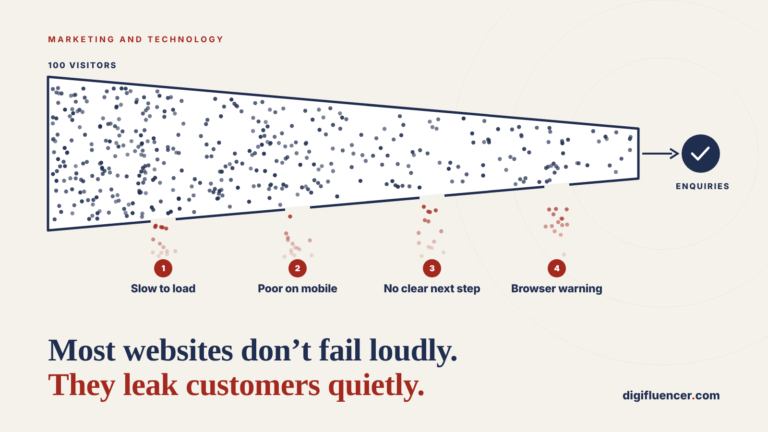
Ignoring technical fundamentals. A brilliant article on a slow, broken site will not rank. Technical health is table stakes.
Neglecting local search. For local businesses, ignoring Google Business Profile and local citations is leaving money on the table.
Expecting overnight results. SEO takes time. Most pages take three to six months to reach their ranking potential. Sites competing in established categories can take 12–24 months to build authority.
Not tracking performance. Without measurement, you do not know what is working. Invest in tools and dashboards that surface your key metrics.
Creating content with no commercial intent. Content should support a business goal. Thousands of blog posts drive no customers. Prioritise keywords and topics that your sales and customer teams identify as important.
An Owner’s Guide: Timelines, People and Investment
How Long Does SEO Take?
A common question from business leaders: when will we see results?
- Quick wins (months 1–3). On-page optimisations, technical fixes and low-competition keywords can start driving traffic within three months.
- Meaningful growth (months 4–12). New content begins to rank, internal linking strengthens, and you start to outrank some competitors. Traffic typically doubles or more in year one.
- Category authority (years 2–3). Your site becomes known in search for your primary categories. You rank for competitive, high-volume keywords. Traffic can be 5–10 times higher than year one.
- Compounding returns (years 3+). A mature site with dozens of ranked pages and strong authority attracts new keywords without new content. This is where ROI becomes exceptional.
The key insight: patience pays. The longer you commit to SEO, the better the returns.
People and Skills
In-house team:
- SEO Specialist (1–2). Manages keyword research, content planning, on-page optimisation and performance tracking.
- Content Creator/Editor (1–2). Produces and edits the articles, guides and content that fills your roadmap.
- Technical Lead. Oversees site speed, mobile experience, schema implementation and crawlability.
- Link Builder/Communications. Develops relationships with journalists, bloggers and partners for link building and PR.
Agency partnership: Many businesses outsource to an SEO agency or partner. This works well if:
- The agency takes a long-term, outcome-focused approach (not just link building or keyword stuffing).
- There is clear alignment on what success looks like (traffic, conversions, revenue impact).
- The agency integrates with your content and product teams, not just your marketing department.
Investment and ROI
Costs vary widely: a small business optimising a ten-page site might invest £2,000–5,000 to get started. A mid-market company building a content programme and link strategy might invest £20,000–50,000 annually. An enterprise programme can be £100,000+.
Return on investment:
SEO is one of the few channels with improving ROI over time. Initial investment is front-loaded; returns compound.
- Year 1. Expect a 2–3x return on investment, assuming you started from zero visibility.
- Year 2–3. As your authority builds and you rank for more queries, returns can be 5–10x.
- Year 3+. Mature programmes often see 10–20x returns, with new content needing minimal incremental investment to rank.
These numbers assume your content drives customers (i.e., you are optimising for keywords your prospects search for). A business optimising for vanity metrics will see no return.
Key Performance Indicators
To manage SEO, track these metrics:
Rankings. Monitor your position for target keywords monthly. Tools like SEMrush and Ahrefs track this automatically.
Organic search traffic. Track overall traffic from Google and other search engines. Monitor trends over time. Break down by page, category and device (desktop vs. mobile).
Click-through rate (CTR). Track the percentage of Google search impressions that result in clicks. Improve title tags and meta descriptions to lift CTR.
Conversion rate. Track the percentage of search visitors who complete your conversion goal (purchase, sign-up, call, quote request). SEO is only valuable if it drives conversions.
Revenue per search visitor. Divide monthly revenue from search visitors by the number of search visitors. This metric connects SEO directly to business results.
Backlink profile. Monitor the number and quality of backlinks pointing to your site and your competitors. Tools like Ahrefs and Moz provide backlink counts and authority scores.
Page speed and core web vitals. Track pages’ loading time and user experience metrics (largest contentful paint, first input delay, cumulative layout shift). Google uses these to rank pages.
Glossary
Anchor text. The visible, linked text in a hyperlink. “Click here” is weak anchor text; “guide to implementing agile” is strong.
Authority (domain authority). A metric (0–100) that predicts how likely a website is to rank. Authority comes from backlinks, brand presence and content quality. Higher authority sites tend to rank higher.
Backlink. A link from one website to another. Often called an inbound link.
Bot. An automated crawler or spider that indexes web pages for search engines.
Canonical tag. An HTML tag that tells search engines which version of a page to index when duplicate or similar content exists across your site.
Click-through rate (CTR). The percentage of people who see your search result and click on it.
Crawl. The process of search engine bots reading and following links across your website.
E-E-A-T. Experience, Expertise, Authoritativeness, Trustworthiness. A Google framework for assessing content quality.
Index. Google’s massive database of web pages, numbering in the hundreds of billions.
Keyword. A word or phrase people type into search engines.
Meta description. An HTML tag that summarises the content of a page. It appears below the title tag in search results.
Organic search. Unpaid search results, as opposed to paid advertisements.
Page speed. How quickly a page loads. A key ranking factor.
Rank. A page’s position in search results for a specific keyword (e.g., “rank 1” means the first position).
Schema. Structured data markup that helps search engines understand the content and context of your pages.
Sitemap. A file (XML sitemap) that lists all pages on your website, helping search engines crawl and index you more efficiently.
Title tag. An HTML tag that names a page and appears in search results, browser tabs and when shared on social media.
Frequently Asked Questions
Q: How long before I rank on the first page of Google?
A: It depends on your site’s authority, the competition for your target keywords, and the quality of your content. For low-competition keywords, three to six months is typical. For high-competition keywords, it can take 12–24 months or longer.
Q: Do I need to update my old blog posts for SEO?
A: Not every post. Prioritise posts that rank but could be improved, or that target high-value keywords. Refreshing a post that brings ten visitors a month is low ROI. Refreshing a post that brings 100 visitors but is dated or less comprehensive is worthwhile.
Q: How many backlinks do I need to rank?
A: Quality over quantity. One backlink from a highly authoritative, relevant site is worth more than 100 links from low-quality sites. Focus on earning links from publications, partners and organisations your customers respect.
Q: Does Google penalise you for using the same keyword too many times on a page?
A: No, but excessive keyword repetition looks unnatural to both humans and search algorithms, and it typically results in lower rankings. Use natural language and write for humans first.
Q: Can I buy my way to the top of Google?
A: No. Buying links violates Google’s webmaster guidelines and can result in manual penalties. Buying paid ads gets you visibility, but organic rankings cannot be bought directly. They are earned through content quality and authority.
Q: What about voice search and SEO?
A: Voice searches tend to be longer and more conversational than typed searches (e.g., “how do I reduce heating costs in an old house” instead of “reduce heating costs”). Optimising for featured snippets (position zero in Google) and long-tail keywords helps with voice search visibility.
Q: Is local SEO different from regular SEO?
A: It overlaps significantly, but local SEO adds layers: Google Business Profile optimisation, local citations, reviews and location-specific content. For businesses with physical locations or regional services, local is critical.
Q: How much should SEO cost as a percentage of my marketing budget?
A: There is no standard answer, but many organisations allocate 15–30% of their digital marketing budget to SEO. The payoff improves over time, making SEO a larger percentage of overall returns in year two and three.
Digifluencer helps organisations build search visibility as a driver of sustainable business growth. Our growth services cover SEO strategy, content development and link building. We work with business leaders to ensure that SEO investment is clearly tied to business outcomes: traffic, conversions and revenue. Discuss your search strategy with Digifluencer.
Sources
- Google, “Search in 2025: The Evolution of AI and Search,” March 2025. https://www.google.com/search/
- Statcounter Global Stats, “Search Engine Market Share,” September 2026. https://gs.statcounter.com/
- Alphabet Investor Relations, “Q2 2026 Earnings Report,” July 2026. https://www.alphabet.com/
- Similarweb, “The State of Digital Marketing 2026,” July 2026, reported by Search Engine Journal, July 2026. https://www.searchenginejournal.com/
- Pew Research Center, “Navigating Search Results and AI-Powered Tools,” July 2025. https://www.pewresearch.org/
- Microsoft Azure Architecture Center and Google Search Central, “How Search Engines Work,” 2026. https://learn.microsoft.com/ and https://developers.google.com/search