meta_ti
Your buyer asks an AI for “the best provider” and gets three names and no list of links. Either you are one of the three, or you do not exist.
At a glance
- The shift: more buyers now get a synthesised answer first and click second, or not at all. Being named inside the answer is the new first page.
- The good news: there is no secret trick. AI search rewards the same things good search always has: clear, trustworthy, well-structured, widely referenced information. Most competitors have simply not organised theirs.
- The framework: five parts, which we call CITED: Crawlable, Identifiable, Trusted, Extractable, Distributed.
- The test: a free 20-question citation audit tells you in an afternoon where you stand.
- The timeline: most mid-market companies can fix the fundamentals in 30 days.
The new first page
For twenty years, the goal was a position on a page of ten blue links. That page still exists. But above or instead of it, buyers increasingly meet an AI-written answer: Google’s AI Overviews and AI Mode, ChatGPT with search, Perplexity, Microsoft Copilot and others.
These systems do not rank pages the way a list does. They read many sources, assemble an answer and name the few businesses or pages they trust enough to mention. For a mid-market company, that changes the question from “do we rank?” to “are we named?”
Two things follow:
- Being named is a recommendation. The buyer did not choose you from a list. The AI did it for them, so the trust transfers.
- Not being named is silent. There is no page-two consolation prize. Your analytics may show nothing at all, because the loss happens before the click.
What has not changed
Before the framework, a reality check against the hype. Google’s own guidance on AI features in Search says that the same foundational practices apply: crawlable pages, helpful original content, good page experience, and no special markup is required to appear in AI Overviews. In other words, there is no separate “AI trick” to buy.
What has changed is how much weight goes to certain things: clear answers, named entities, evidence of real expertise, and whether other trustworthy places mention you. That is what the framework addresses.
If you have already invested in the basics, our SEO guide covers the foundation. This article assumes the foundation exists and shows what to add.
The CITED framework
| Letter | Principle | The question |
|---|---|---|
| C | Crawlable | Can AI systems reach and read our pages? |
| I | Identifiable | Is it clear who we are, what we do and who for? |
| T | Trusted | Do we show real expertise and proof? |
| E | Extractable | Can an AI lift a clear, accurate answer from our content? |
| D | Distributed | Do credible places beyond our site mention us? |
C: Crawlable
If an AI system cannot reach your pages, nothing else matters. Check four things:
- robots.txt. AI products use different crawlers for different jobs. OpenAI, for example, documents separate bots for search results, user-initiated browsing and model training, so you can allow search visibility while limiting training use if you choose. Do not block search crawlers by accident with a blanket rule.
- Security layers. Firewalls, bot-protection settings and CDNs sometimes block legitimate crawlers. Ask your host or developer to confirm.
- Indexing. Pages that are not indexed by search engines are usually invisible to AI search too. Use Search Console and Bing Webmaster Tools, and submit a sitemap.
- Rendering. Key content that appears only after heavy JavaScript runs can be missed. Important text should be in the page’s HTML.
I: Identifiable
AI systems build a picture of “entities”: companies, people, products and the relationships between them. A vague entity does not get recommended.
- State plainly, on your homepage and About page, what you do, for whom, and where. Avoid slogans that say nothing.
- Use consistent naming everywhere: website, LinkedIn, directories, press. Variations such as “Digifluencer” and “Digifluence” split the signal.
- Add structured data (schema.org markup for Organization, Service, Article, FAQ and Person) so the facts are machine-readable.
- Give each service its own page with a clear description, rather than one vague “solutions” page.
T: Trusted
AI systems are cautious about recommending. They lean on signals of real experience and accountability.
- Name your experts. Real authors with real bios and credentials, linked to profiles.
- Show proof. Case studies with real, specific results. Client names where permitted; anonymised results where not.
- Cite original sources. Link to the standards and research you rely on, not to competitors.
- Keep it current. Date your content and update it. An article about “2024 trends” does not get cited in 2027.
- Publish original data. A survey, benchmark or audit of your own is the most citable asset a company can create, because nobody else has it.
E: Extractable
This is the part most companies fail, and the quickest win. AI systems pull answers from passages. Make passages easy to pull.
- Lead with the answer. Under every question-style heading, give the direct answer in the first one or two sentences, then explain.
- Use question headings that match how buyers actually ask: “How much does a website redesign cost?”, “What is a progressive web app?”
- Use tables, short lists and definitions for comparisons and steps. They are easy to quote accurately.
- One idea per section. Long, winding paragraphs lose meaning when excerpted.
- Be specific. Numbers, ranges and conditions beat adjectives. “From four to eight weeks, depending on integrations” is quotable. “Fast turnaround” is not.
- Add an FAQ to key pages, written in plain language.
D: Distributed
AI systems form a view of you from the wider web, not just your own site. If only your website says you are good, that is a weak signal.
- Earn mentions on credible third-party sites: industry publications, partner pages, podcasts, conference pages, reputable directories.
- Be active where buyers and experts talk: LinkedIn, relevant communities, Q&A sites. Give real answers; do not spam.
- Collect genuine reviews on the platforms your customers use.
- Be quoted. Commentary and data that journalists and bloggers reference carry weight.
- Remember that the same facts should appear consistently in each place.
The 20-question citation audit
You can measure where you stand today in an afternoon, with no software.
Step 1. Write 20 questions your ideal buyer would actually ask. Mix four types:
- Category: “What is the best [your service] company for [your buyer type]?”
- Comparison: “[Your name] vs [alternative]” or “Which is better, X or Y?”
- Problem: “How do I fix [problem you solve]?”
- Brand: “Is [your company] good for [use case]?”
Step 2. Ask each question in ChatGPT (with search on), Google (look for the AI Overview or AI Mode), Perplexity and Copilot. Use a fresh browser session and the same wording each time.
Step 3. Record, in a simple sheet: Were we named? Were we linked? Who was named instead? What source did the AI cite?
Step 4. Score yourself. For each question, 1 point for named, 1 more for linked. Then read what the AI says about you, because errors there show you what needs fixing.
Step 5. Repeat monthly, with the same questions, to see movement. Results vary between runs, so look for trends, not single answers.
The “who was named instead” column is the most valuable. It shows you exactly which sources the AI trusts in your category, and where you need to appear.
Common mistakes
- Treating it as a hack. There is no keyword stuffing for AI. Pages written for machines read badly and are not trusted.
- Blocking everything. Some companies block all AI crawlers out of caution and then wonder why they are never named. Decide deliberately.
- Thin content at scale. Mass-produced, generic AI-written articles add noise, not authority.
- Ignoring the wider web. A perfect website with no outside mentions is a weak signal.
- Measuring only clicks. AI visibility can lift brand searches and direct enquiries without a matching click trend. Track branded search, direct traffic and enquiry quality too.
A 30-day plan
Week 1: Baseline and access
- Run the 20-question audit.
- Check robots.txt, security settings and indexing.
- Set up Search Console and Bing Webmaster Tools.
Week 2: Identity
- Rewrite the homepage and service pages to state clearly who you serve and what you do.
- Add structured data.
- Make your name and descriptions consistent across profiles.
Week 3: Content
- Pick your five most valuable pages. Add answer-first openings, question headings, a table and an FAQ to each.
- Add named authors, dates and proof points.
Week 4: Distribution and measurement
- Identify the sources the AI cited in your audit. Plan outreach to appear on the best three.
- Publish one piece of original data or a proper case study.
- Set the monthly audit and track branded search.
What this means for leaders
AI search does not replace the fundamentals. It raises the reward for doing them well and exposes companies that have not. The businesses that get named are those that are clear about who they are, can prove it, answer questions directly and are talked about elsewhere.
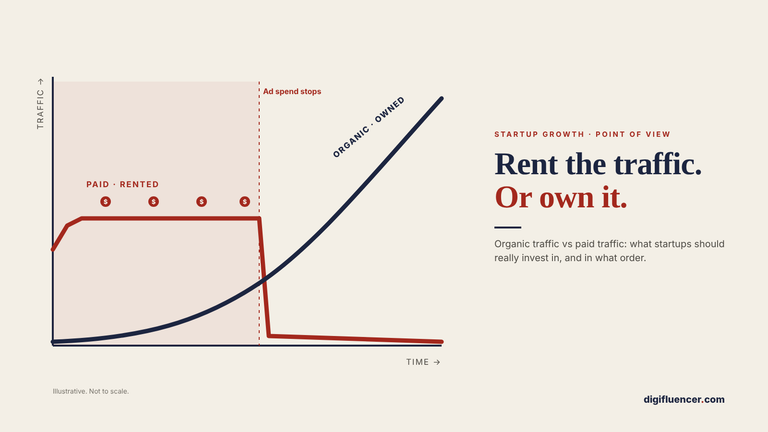
That is not a one-off project. It is a habit: publish genuinely useful, specific content; show your expertise; earn mentions; measure; repeat. Compared with paid acquisition, which stops when the budget does, this compounds. Our piece on organic versus paid traffic for startups explains why.
Where Digifluencer can help
Digifluencer works with growing businesses on search, content, web engineering and applied AI. Our AI Search Visibility Audit runs the full citation test across the major AI platforms for your category, shows which sources they trust, scores you against the five CITED principles and delivers a prioritised 30-day plan.
Request an AI Search Visibility Audit · Explore our growth services · See our AI engineering work
About Digifluencer. Digifluencer is a digital and technology firm helping growing businesses build secure websites, grow organic demand and adopt applied AI safely.
Sources and further reading
- Google Search Central, “AI features and your website”: https://developers.google.com/search/docs/appearance/ai-features
- OpenAI, “Overview of OpenAI crawlers”: https://platform.openai.com/docs/bots
- Schema.org, structured data vocabulary: https://schema.org/