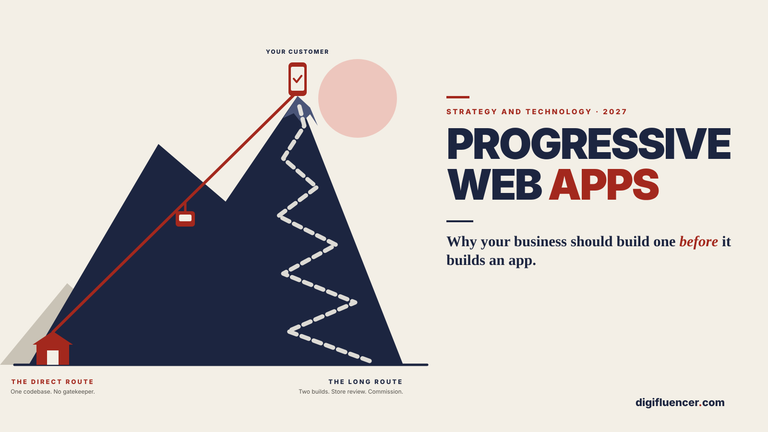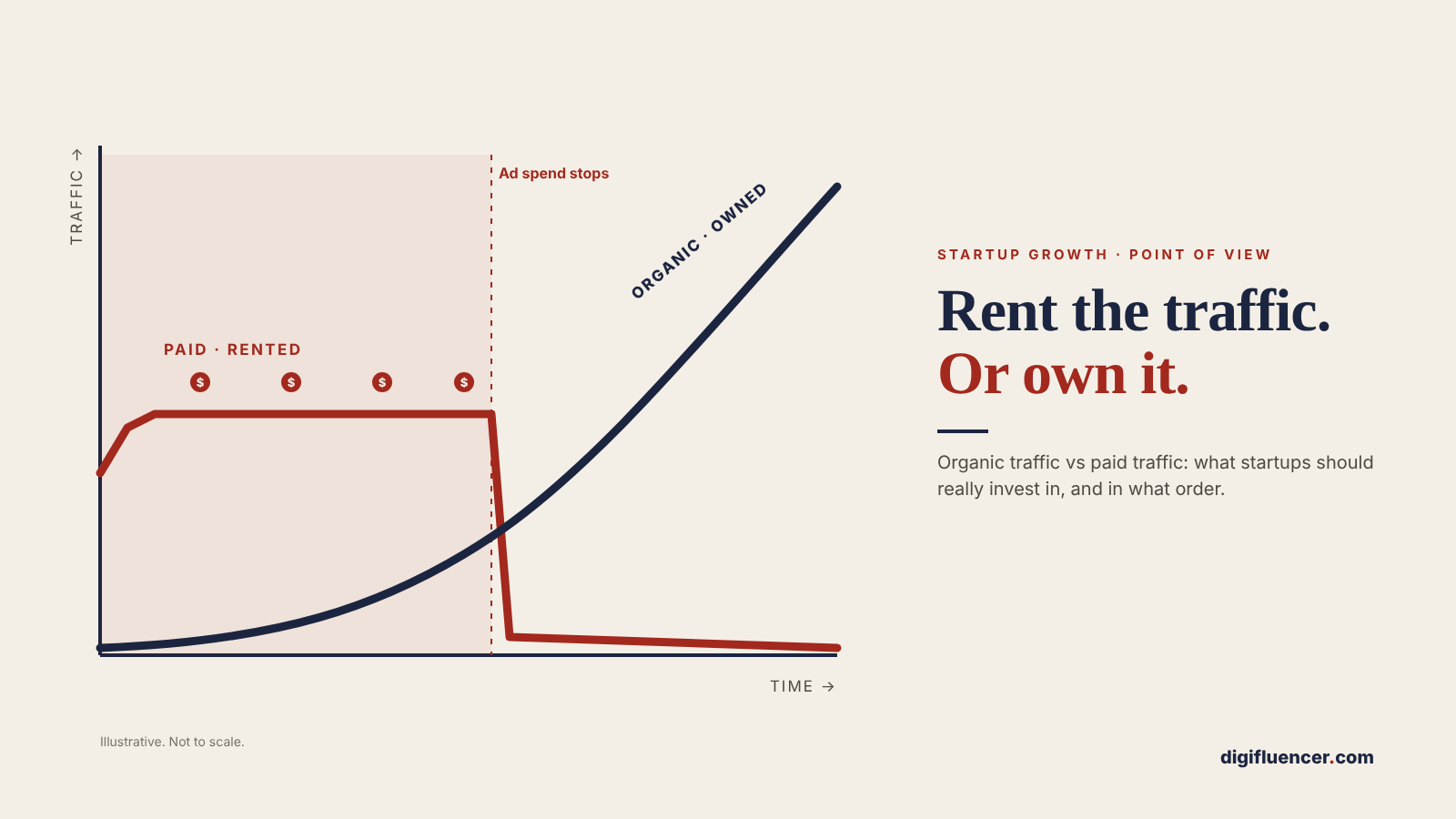
Every founder eventually faces the same budget conversation: do we pay for growth now, or build it to last? It is usually framed as a choice between two channels. It is better understood as a choice about what the business will own in two years’ time. A point of view for founders, early-stage marketing leads and the investors who back them.
At a glance
- Organic traffic vs paid traffic is the wrong fight. Paid traffic is rented: it stops the day the budget does. Organic traffic is owned: it compounds, but slowly. Startups need both, in the right order, and neither works without a website that turns visitors into conversations.
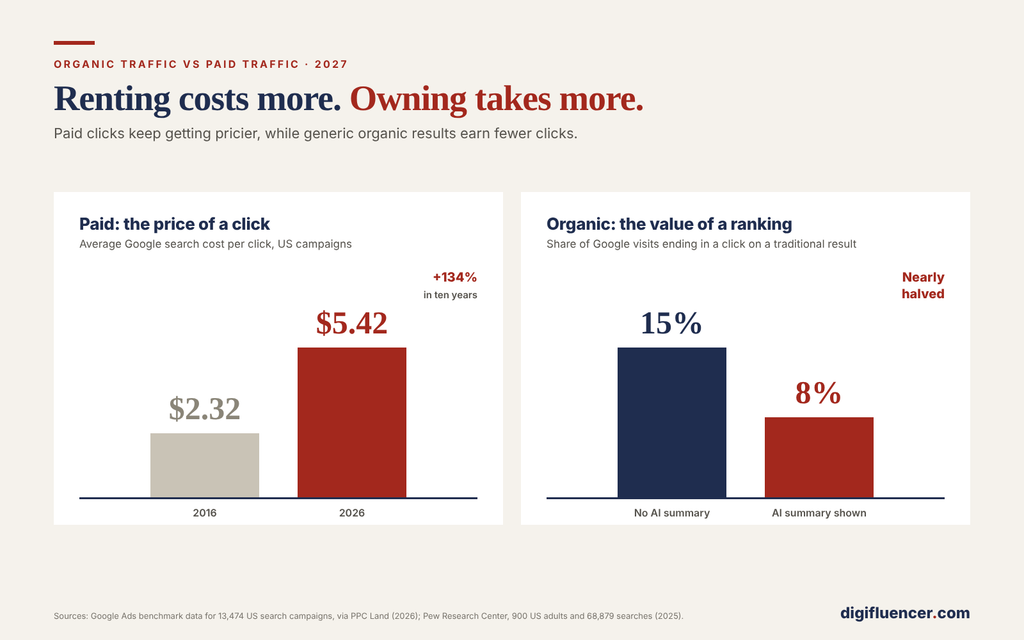
- Renting is getting more expensive. The average cost per click on Google search ads has risen from $2.32 in 2016 to $5.42 in 2026, an increase of 134% (industry benchmark of 13,474 US campaigns, via PPC Land). Meta’s average price per ad rose 14% year on year in the third quarter of 2026 (Meta, Q3 2026 results).
- Owning is getting harder, too. When Google shows an AI summary, users click a traditional result on 8% of visits, against 15% when no summary appears (Pew Research Center, 2025). Generic content no longer earns attention. Expertise does.
- Cash, not competition, is what ends most startups. Running out of money was the final cause in 70% of venture-backed shutdowns studied by CB Insights, and unsustainable unit economics in 19% (CB Insights, via Crowdfund Insider).
- Our guidance: invest first in the asset both channels depend on, a website that converts. Use paid traffic as a learning instrument before product-market fit, build an organic engine as soon as you know what customers ask, and scale paid only to amplify what is already proven.
The question founders ask, and the one they should
The conversation usually begins in a board meeting or a founders’ Slack channel. Revenue needs to move. There is a marketing budget, perhaps a modest one. Someone asks: should we put it into ads, or into SEO?
It is a reasonable question. It is also a question about tactics, asked at a moment that calls for strategy.
The debate over organic traffic vs paid traffic tends to be argued on the channels’ own terms: cost per click against cost per article, speed against longevity. Those comparisons matter. But they skip the question an investor would ask first: what will this spend leave behind?
Paid media buys attention for as long as you pay for it. When the campaign stops, the traffic stops, and the business is left with whatever it learned and whatever it converted. Organic search builds an asset: pages that rank, content that is cited, a domain that search engines and AI assistants trust. That asset keeps working after you pay the invoice. It also takes months to build, and many startups do not have months to spare.
So the right question for a founder is not organic or paid? It is:
What should we own, what should we rent, and in what order?
That is the question this article sets out to answer.
Rent or own: how the two channels really differ
Before deciding where to invest, it helps to be precise about what each channel is, and what it is not.
| Paid traffic | Organic traffic | |
|---|---|---|
| What you are buying | Attention, one click at a time | An asset that earns attention over time |
| Speed to first result | Days | Typically three to twelve months |
| What happens when spend stops | Traffic stops almost immediately | Traffic decays slowly, often over years |
| Cost curve | Rises with competition and scale | Falls per visitor as the asset matures |
| Best use | Testing messages, launching offers, capturing proven demand | Answering buyer questions, building authority, lowering blended acquisition cost |
| Main risk | Spending faster than you learn | Waiting too long to start |
| What it leaves behind | Data and customers, if you capture them | Rankings, citations, content and trust |
Neither column is better. They do different jobs. The mistake is to ask one channel to do the other’s job: to expect paid ads to build lasting authority, or to expect a blog launched last month to fill this quarter’s pipeline.
Four forces reshaping the decision in 2027
The trade-off between owning and renting traffic has always existed. What has changed is the cost of each side of it.
1. Rented attention keeps getting more expensive
The price of paid traffic has moved in one direction for a decade. Across more than 13,000 US search campaigns, the average cost per click reached $5.42 in the year to March 2026, up from $2.32 in 2016 (via PPC Land). The average cost per lead was $66.69. It fell slightly this year for the first time since 2020, but remains well above where it was a decade ago.
Social advertising is following the same path. In the third quarter of 2026, Meta delivered 10% more ad impressions than a year earlier, yet the average price per ad rose 14% and advertising revenue grew 26% to $63 billion (Meta, Q3 2026 results).
Large advertisers are adding to the pressure. Gartner’s 2026 CMO Spend Survey found that awareness and conversion now take 62.6% of total media spend, up more than 10% since 2024, while digital accounts for more than two-thirds of media investment (Gartner, June 2026). A startup bidding for the same buyers is bidding against those budgets.

Implication for founders: a growth plan that depends entirely on paid traffic gets more expensive every year, even if nothing about the business changes.
2. Organic visibility has been redefined by AI
The case for organic traffic has changed too, and not only in its favour. Pew Research Center tracked the browsing of 900 US adults across nearly 69,000 Google searches. When an AI summary appeared, users clicked a traditional search result on 8% of visits. Without one, they did so on 15%. Links inside the summary itself were clicked on just 1% of visits (Pew Research Center, 2025).
This does not mean organic search is dying. It means the reward for being a result has fallen, while the reward for being the source has risen. AI summaries are assembled from pages that search engines already trust. The startups that appear in them are those with clear, specific, expert content on a fast and well-structured site. We set out what that foundation looks like in our complete guide to SEO strategy.
Implication for founders: thin, generic content is now close to worthless. Organic investment only pays when it is built on genuine expertise about the problems your buyers are trying to solve.
3. Cash runway is the constraint that matters most
CB Insights examined 431 venture-backed startups that shut down after 2023. Running out of cash was the final step in 70% of cases. Poor product-market fit was a factor in 43%, and 19% failed on unsustainable unit economics, where the cost of acquiring or serving customers exceeded the revenue they brought in (CB Insights, via Crowdfund Insider).
That has a direct bearing on the organic traffic vs paid traffic decision. Paid acquisition can make a dashboard look healthy while quietly burning runway. Organic growth protects runway, but only if the startup survives long enough to benefit from it.
Implication for founders: every acquisition dollar should be judged on two tests. Does it bring in customers at a cost the business can sustain? And does it teach us something, or build something, that makes the next customer cheaper?
4. Buyers decide before they talk to you
Gartner found that 67% of B2B buyers prefer a rep-free buying experience (Gartner, March 2026). Consumers behave the same way. They research, compare and shortlist on their own, using search, AI assistants, reviews and your website.
By the time a prospect clicks an ad or reads an article, much of their decision has been formed. Whether they contact you depends far less on how they arrived than on what they find when they get there.
Implication for founders: the website is where both channels succeed or fail. A startup that pays for traffic before its website can earn trust is, in effect, paying to disappoint people.
What startups should really invest in
Once the question changes from which channel? to what should we own?, the priorities become clearer. We recommend founders fund five things, broadly in this order.
1. A website that converts the traffic you already have
Every dollar of paid traffic and every hour of content ends on the same pages. If those pages are slow, vague or untrustworthy, both channels underperform, and the founder concludes the channel failed when it was the destination.
A converting startup website does four things well. It states plainly who the product is for and what problem it solves. It shows evidence: customers, results, credentials, security. It loads quickly on a phone. And it gives a ready buyer an obvious, low-friction next step.
Most early-stage sites fall short on at least one of these. Our checklist of the signs your website is costing you customers is a quick way to find out where yours stands. For service-led startups, our guide to building a website for a consulting business covers the same principles in depth.
Why first: improving conversion improves the return on every other investment. A site that converts at 2% rather than 1% halves the cost of every customer you acquire, whichever channel they came from.
2. Paid traffic as a learning instrument
Before product-market fit, the most valuable thing paid media can buy is not customers. It is evidence. Small, disciplined campaigns can tell a founder within weeks which problem statement resonates, which audience responds, which offer converts and what a customer is likely to cost.
That knowledge would take an organic programme months to surface. Used this way, paid traffic is research with a fast feedback loop.
The discipline lies in the rules. Set a fixed test budget. Define the question each campaign is meant to answer. Agree in advance what result would make you stop, change or scale. And capture every learning, because the winning messages from paid tests become the headlines, page titles and content themes of the organic programme.
Why second: paid traffic is the quickest way to learn what to build organically. Startups that skip this step often spend a year writing content about problems their buyers do not prioritise.
3. An organic engine built on buyer questions
Once a startup knows what its customers are asking, it should start building the asset that answers them. That means content and pages mapped to real searches across the buying journey: the problem, the category, the comparison, the cost and the decision.
In 2027, this engine has to serve two audiences. Human readers need clear, credible answers. Search engines and AI assistants need well-structured, authoritative pages they can confidently cite. The work is the same: specific expertise, clearly organised, on a technically sound site. Our growth services are built around exactly this combination of search, content and AI visibility.
Why third: organic traffic compounds, so the earlier it starts the more it is worth. But it compounds fastest when it is aimed at questions you already know buyers are asking.
4. Measurement that follows the customer, not the click
Many startups cannot answer a simple question: which channel brought in our best customers? Tracking stops at the click or the form, so paid campaigns are judged on cost per lead and content on page views. Neither measure says much about revenue.
A founder needs to see the whole path: where a customer first found the business, what they read, how they converted and what they became worth. With that view, the organic traffic vs paid traffic debate stops being a matter of opinion. It becomes a matter of evidence.
Why fourth: without it, budget decisions are made on the metrics that are easiest to count rather than those that matter.
5. A secure, reliable foundation
It is easy to treat security and maintenance as something to fix later. For a startup, later can be expensive. A compromised site can be flagged by browsers and search engines, cutting off organic and paid traffic at once, at exactly the moment the company is trying to build trust.
We have written about what a compromised website does to marketing performance, and why leaders should treat website maintenance cost as an investment in resilience rather than a line to cut. Our cybersecurity and engineering teams work with startups to build that foundation in from the start.
Why fifth: not because it matters least, but because it protects everything above it.
Not sure which of these your startup needs first? Most founders we speak to are investing in at least one of them too early and another too late. A short conversation is usually enough to tell which. Talk to our growth team →
A three-stage model for balancing organic and paid
The right mix of organic traffic vs paid traffic is not fixed. It changes as a startup moves from searching for its market to scaling within it. We use a simple three-stage model with the founders we advise.

Stage 1: Find the fit. Before product-market fit, the job is learning. Paid traffic leads, in small and tightly controlled tests, because it produces answers quickly. Underneath, the startup builds the foundations: a credible, fast website, accurate tracking and the technical basics of search. Content at this stage should be limited to the handful of pages buyers need to make a decision.
Stage 2: Build the engine. Once the startup knows who buys and why, the balance shifts. Organic investment grows, aimed at the questions that paid testing proved buyers care about. Paid continues, but now concentrates on the highest-intent searches and on retargeting people who have already engaged.
Stage 3: Scale what works. With a growing organic base, paid traffic becomes an amplifier. It pushes proven pages and offers to larger audiences, while organic traffic steadily lowers the blended cost of acquiring each customer. The startup is now renting attention to accelerate an asset it owns, rather than to replace one.
The specific split will depend on the market, the sales cycle and the runway. A startup selling a high-value product with a long sales cycle may lean towards organic earlier. One in a category buyers search for by name may lean on paid for longer. The principle holds in each case: rent to learn, own to last, and rent again to accelerate.
Five mistakes that waste a startup’s marketing budget
In our work with early-stage companies, the same patterns recur.
- Buying traffic for a website that cannot convert it. The most common, and the most expensive. Fix the destination before paying for the journey.
- Scaling paid spend before unit economics are proven. Growth that costs more to acquire than it returns is not growth. It is a faster route to the end of the runway.
- Starting SEO too late. Because organic traffic takes months to build, the best time to start is before you need it. Founders who wait until paid costs hurt have already lost a year of compounding.
- Publishing content without a point of view. In an AI-summarised search landscape, generic articles are neither clicked nor cited. Content must reflect genuine expertise about your customers’ problems.
- Judging channels on the wrong metric. Cost per click and page views are easy to count. Cost per qualified customer and customer lifetime value are what decide whether the company survives.
Questions to ask before you spend the next dollar
Before approving the next marketing budget, founders and their boards should be able to answer these questions with confidence.
- Conversion: what percentage of visitors to our key pages take the next step, and how does that compare with a year ago?
- Acquisition cost: what does it cost us to acquire a paying customer from each channel, not just a lead or a click?
- Learning: what has our paid spend taught us about our buyers in the past 90 days, and where has that learning been applied?
- Ownership: what share of our qualified traffic do we own, through organic search, AI citations, direct visits and referrals, rather than rent?
- Runway: if paid spend had to stop tomorrow, how much of our pipeline would remain?
- Resilience: who is accountable for the security and performance of our website, and when was it last reviewed?
If several of these are hard to answer, that is itself the answer. The next investment should go into the visibility to answer them.
Frequently asked questions
Q: Is organic traffic better than paid traffic for a startup?
A: Neither is better in every case. Organic traffic is usually cheaper per visitor over time and keeps working after investment stops, but it is slow to build. Paid traffic delivers results quickly and is excellent for testing, but its cost rises with competition and it stops when the budget does. Most startups need both, in a sequence that matches their stage.
Q: How long does organic traffic take to grow?
A: For a new website, three to six months is typical before meaningful results on less competitive topics, and twelve months or more for competitive ones. Starting with specific, high-intent buyer questions shortens that timeline.
Q: How much should a startup spend on paid ads?
A: There is no universal figure. Before product-market fit, we recommend a fixed test budget sized to answer specific questions, rather than a percentage of revenue. Once unit economics are proven, paid spend can scale in line with what each channel returns.
Q: Does AI search mean SEO is no longer worth it?
A: No. AI summaries draw on the same pages search engines already rank and trust. The reward for generic content has fallen, but the reward for clear, expert, well-structured content has risen, because that is what AI tools choose to cite.
Q: What is the single best first investment for a startup’s growth?
A: In most cases, the website. It is the destination for every channel, and improving how well it converts raises the return on all other marketing spend.
Q: Should we hire in-house or work with a partner?
A: Early-stage startups rarely need a full in-house team across design, engineering, search, content and paid media. A partner can provide that breadth at the stage you need it, while you build internal capability in the areas that will become core.
The bottom line
The organic traffic vs paid traffic debate is often presented as a choice. For a startup, it is a sequence. Paid traffic buys speed and learning. Organic traffic builds an asset that lowers the cost of every future customer. And both depend on a website that earns trust in the few seconds a buyer gives it.
The founders who get this right do not spend more than their competitors. They spend in the right order, measure what matters, and make sure every dollar either teaches them something or builds something they will still own next year.
Digifluencer helps startups and growing businesses turn their websites into dependable engines of growth. Our design, growth and engineering teams work together across the website, search, AI visibility and paid media, so that every channel pulls in the same direction and every dollar is tied to a business outcome.
If you are weighing organic traffic vs paid traffic for your own startup, we would be glad to help you think it through. In a Startup Growth Review, we look at your website, your current channels and your stage of growth, and recommend where your next investment will do the most good. There is no obligation, and you keep the recommendations whatever you decide.
Book your Startup Growth Review →
Sources
- Google Ads benchmark data for 13,474 US search campaigns, April 2025 to March 2026, as reported by PPC Land, June 2026. https://ppc.land/google-ads-cpl-drops-for-first-time-since-2020-as-cpc-hits-5-42/
- Meta Platforms, “Meta Reports Third Quarter 2026 Results,” Form 8-K Exhibit 99.1, 21 October 2026. https://www.sec.gov/Archives/edgar/data/0001326801/000162828026066700/meta-09302026xexhibit991.htm
- Gartner, “Gartner Marketing Survey Finds Awareness and Conversion Account for 62.6% of Total Media Spend,” 8 June 2026 (n=401 CMOs and marketing leaders). https://www.businesswire.com/news/home/20260608855793/en/Gartner-Marketing-Survey-Finds-Awareness-and-Conversion-Account-for-62.6-of-Total-Media-Spend
- Pew Research Center, “Google users are less likely to click on links when an AI summary appears in the results,” 22 July 2025 (n=900 US adults; 68,879 searches). https://www.pewresearch.org/short-reads/2025/07/22/google-users-are-less-likely-to-click-on-links-when-an-ai-summary-appears-in-the-results/
- CB Insights analysis of 431 venture-backed startup shutdowns since 2023, as reported by Crowdfund Insider, March 2026. https://www.crowdfundinsider.com/2026/03/266527-startups-are-increasingly-failing-due-to-cash-flow-challenges-report-claims/
- Gartner, “Gartner Sales Survey Finds 67 Percent of B2B Buyers Prefer a Rep-Free Experience,” 9 March 2026. https://www.gartner.com/en/newsroom/press-releases/2026-03-09-gartner-sales-survey-finds-67-percent-of-b2b-buyers-prefer-a-rep-free-experience