The biggest risk in legacy modernisation is not the old technology. It is the belief that the only way out is a single, high-stakes leap. There is a better path.
by Digifluencer Insights · October 25, 2026
Summary. Most organisations know their legacy systems are holding them back. They consume budgets, slow every new initiative, widen the attack surface and stand between leaders and their ambitions for AI and growth. Yet modernisation keeps being deferred, because leaders have learned to associate it with multi-year programmes, runaway costs and the risk of disrupting the business that pays for it all. That trade-off is false. The organisations that modernise successfully do not choose between transformation and continuity. They modernise in phases, behind a stable front end, starting where value is highest and using the savings from each phase to fund the next. Three moves make this possible: triaging the portfolio by business value rather than technical age, replacing systems incrementally rather than all at once, and designing the programme so that it funds itself.
Every leadership team has a system like this. It was built well, a long time ago, by people who have since moved on. It still runs a critical part of the business, perhaps billing, policy administration, order management or the customer portal. It works, mostly. But every change takes months. Every integration needs a workaround. The few engineers who understand it are close to retirement, and its software stack is approaching, or already past, the end of vendor support.
Leaders know it needs to be replaced. They also remember what happened the last time someone tried: a large programme, a fixed go-live date, a budget that doubled and a cutover weekend that nobody wants to repeat. So the system stays. Each year, a little more budget is spent keeping it alive, and a little more ambition is quietly shelved because the system cannot support it.
This is the legacy trap. And for many organisations, the cost of staying in it now exceeds the cost of getting out.
Legacy Systems Have Become a Strategic Constraint, Not Just a Technical One
For years, legacy technology was framed as an IT problem: expensive to run, hard to staff, a little embarrassing. That framing understates the issue. Today, legacy systems constrain growth, security and the ability to adopt new technology, all at once.
They consume the budget meant for growth. The US Government Accountability Office reports that federal agencies have typically spent about 80% of more than $100 billion in annual IT spending on operating and maintaining existing systems, including legacy systems. Of the 11 critical federal systems GAO identified as most in need of modernisation, the oldest are around 60 years old (GAO, 2025). The private sector faces the same pressure. In research by Pegasystems and Savanta covering more than 500 IT decision makers, enterprises were estimated to lose more than $370 million each year on average through inefficient legacy modernisation, and only 9% said their transformation efforts had positioned them to fully retire their legacy applications (Pegasystems, 2025).
They slow the people who build the future. In Atlassian research, 69% of developers reported losing eight or more hours a week to inefficiencies, and technical debt was the single largest source of friction, cited by 59% (Atlassian, via ShiftMag). Every hour spent working around old systems is an hour not spent on new products, better customer experiences or AI.
They widen the attack surface. Of GAO’s 11 critical systems, seven had known cybersecurity vulnerabilities and four relied on unsupported hardware or software. The October 2026 disclosure of the PHP2Shell vulnerabilities showed how quickly that exposure becomes real: organisations running end-of-life versions of PHP faced critical flaws with no official fix for their version. (We cover the response in our briefing on PHP security vulnerabilities.)
They make outages more likely and more expensive. Splunk’s 2026 research on downtime among Global 2000 companies identifies outdated, unpatchable legacy infrastructure among the leading causes of unplanned downtime, which it values at $600 billion a year across those organisations (Splunk, 2026).
They block the next wave of value. AI agents, real-time personalisation and connected customer journeys all depend on clean data and accessible systems. An organisation whose core data sits inside a decades-old system cannot use it at the speed its ambitions require.
The cost of staying in the legacy trap now often exceeds the cost of getting out.
Why Big-Bang Rewrites Keep Failing, and Why Leaders Keep Avoiding Modernisation
If the case for modernisation is so strong, why do so many organisations defer it? Because the most familiar approach, the big-bang replacement, concentrates risk in exactly the wrong place.
A big-bang programme asks the business to keep the old system running while a new one is built in parallel, often for years, and then to switch everything over at once. It assumes that requirements captured at the start will still be right at the end, that the new system will replicate decades of undocumented business rules, and that a single cutover will go smoothly. Each of those assumptions is fragile. Together, they explain why leaders approach modernisation with such caution.
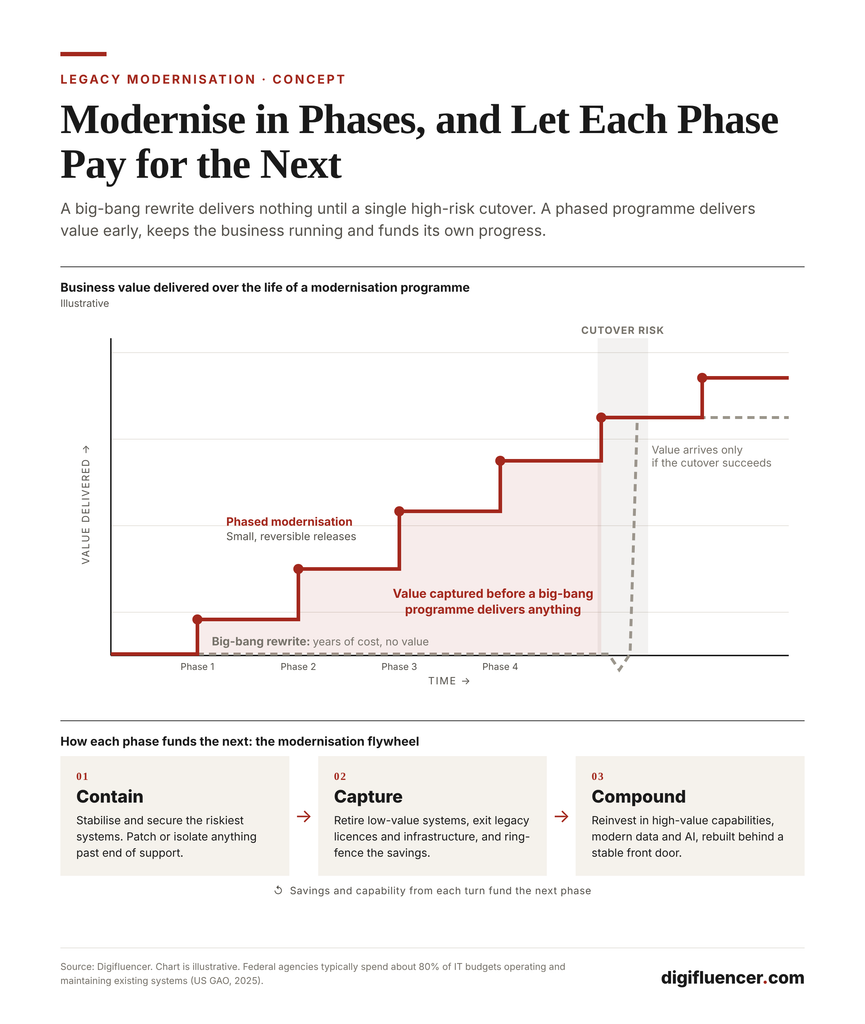
The deeper problem is economic. A big-bang programme delivers no value until the very end. Costs accumulate for years before any benefit is realised, which makes the programme politically vulnerable and financially exposed. When budgets tighten, it is the first thing to be cut, often leaving the organisation with two partially working systems instead of one.
The lesson is not that modernisation is too risky. It is that modernisation done all at once is too risky. The alternative is to change the shape of the programme.
Three Moves That Make Legacy Modernisation Safe, Fast and Self-Funding
Move 1: Triage the Portfolio by Business Value, Not Technical Age
Not every legacy system needs to be modernised, and not every old system is a problem. The starting point is a clear-eyed view of the portfolio, assessed on two dimensions: the business value each system supports, and its technical health, covering security, supportability, cost to run and ability to change.
Exhibit 1: Legacy Portfolio Triage
Assess every system on business value and technical health. Modernise first where both the value and the risk are highest. MODERNISE FIRST High value, poor health.Highest risk and highest return.Start the programme here. SUSTAIN AND EXTEND High value, good health.Protect, open up through APIsand keep current. RETIRE Low value, poor health.Decommission or consolidate,and release the savings. TOLERATE Low value, good health.Leave in place and reviewon a regular cycle. PoorGood TECHNICAL HEALTH → HighLow BUSINESS VALUE →
Source: Digifluencer.
This triage changes the conversation. Instead of a single, overwhelming programme, leaders see a sequence of targeted decisions. Systems in the Retire quadrant are often the fastest source of savings. Systems in the Modernise first quadrant are where the programme should focus its effort, because they combine the greatest business importance with the greatest risk.
Move 2: Replace Systems Incrementally, Behind a Stable Front Door
The most reliable way to modernise a critical system without disrupting the business is to replace it piece by piece while it continues to run. Software architects call this the strangler fig pattern, after the vine that gradually grows around a tree until it can stand on its own.
In practice, a stable interface, or façade, is placed between customers and the legacy system. Behind it, individual capabilities are rebuilt one at a time, and traffic is shifted to each new component as it proves itself. Customers and employees continue to use the same front door throughout. When the last capability has moved, the legacy system is switched off (Microsoft Azure Architecture Center).
This approach changes the risk profile of modernisation in four ways:
- There is no single cutover. Each step is small, testable and reversible.
- The business keeps running. Revenue-generating processes are never switched off.
- Value arrives early. The highest-value capabilities can be modernised first, so benefits start in months, not years.
- Learning compounds. Each phase improves the team’s understanding of the legacy system’s hidden rules and makes the next phase faster.
To protect revenue specifically, we recommend four disciplines alongside the pattern: run old and new components in parallel and compare outputs before switching; release to a small segment of customers before scaling; treat revenue and customer experience metrics as formal gates for each phase; and modernise the data layer early, because clean, accessible data is what most new capabilities, including AI, ultimately depend on.
Modernisation done all at once is too risky. Modernisation done in phases can pay for itself.
Move 3: Design the Programme to Fund Itself
The final move addresses the question that stops most modernisation programmes before they start: who pays?
A phased programme can be designed so that each wave releases savings that fund the next. We describe this as the modernisation flywheel, which turns in three stages.
Contain. Stabilise and secure the highest-risk systems first: patch or isolate unsupported components, reduce the attack surface and remove the most urgent operational risks. This protects the business while the programme builds momentum.
Capture. Retire redundant systems, consolidate overlapping applications, exit expensive legacy licences and infrastructure, and reduce the manual workarounds that legacy systems demand. These savings are tracked explicitly and ring-fenced, not absorbed back into general budgets.
Compound. Reinvest the captured savings into modernising the next set of high-value capabilities and into new growth initiatives that modern systems make possible. Each turn of the flywheel increases both the savings available and the organisation’s capacity to change.
Exhibit 2: The Modernisation Flywheel
Each phase releases savings and capability that fund the next.
| Stage | Objective | Typical actions | What it releases |
|---|---|---|---|
| 1. Contain | Reduce immediate risk | Patch or isolate unsupported components, harden security, stabilise operations | Lower exposure to breaches, outages and compliance failures |
| 2. Capture | Release cost | Retire low-value systems, consolidate applications, exit legacy licences and infrastructure, automate workarounds | Ring-fenced savings to fund modernisation |
| 3. Compound | Build capability | Rebuild high-value capabilities behind a stable façade, modernise data, enable AI and new products | Faster change, new revenue opportunities and further savings |
Source: Digifluencer.
The flywheel matters as much for governance as for finance. Because value is delivered in every phase, the programme earns its continued funding with evidence rather than promises. That makes it far more resilient to budget cycles and leadership changes than a programme that asks for years of faith.
What Successful Modernisation Programmes Get Right
Across the organisations that modernise well, we see five consistent characteristics.
They frame modernisation as a business programme. It has a business sponsor, business outcomes and business metrics, not just a technology roadmap.
They sequence by value and risk. The first phase targets a capability where success is visible to the business and the risk of inaction is high.
They invest in understanding before rebuilding. Legacy systems contain decades of embedded business rules. Successful programmes document and test those rules before replacing them, rather than discovering them after go-live.
They modernise skills alongside systems. The engineers who know the legacy estate are among the most valuable people in the programme. Pairing them with teams building the new platform protects knowledge and accelerates delivery.
They measure relentlessly. Cost to run, speed of change, incident rates, security posture and customer outcomes are tracked from the start, so the value of each phase is visible.
Six Questions Every Leadership Team Should Ask About Its Legacy Estate
- Which of our systems support our most important revenue streams, and how healthy are they?
- How much of our technology budget goes to keeping existing systems running, and how has that changed over three years?
- Which systems are running software that is past, or close to, the end of vendor support?
- What growth or AI initiatives have we delayed or abandoned because our systems could not support them?
- If our most critical legacy system failed tomorrow, how long would it take to recover, and who knows how to fix it?
- Is our modernisation plan designed to deliver value in phases, or does it depend on a single, high-risk cutover?
Legacy systems were built to give organisations an advantage, and for many years they did. The challenge now is not to discard that legacy, but to carry its value forward onto a foundation that can support what comes next.
That transformation does not require a leap of faith. It requires a clear view of the portfolio, the discipline to modernise in phases and a programme designed to fund itself. Organisations that take that path will find that modernisation is not a disruption to the business. It is how the business avoids being disrupted.
Digifluencer helps organisations modernise legacy systems without disrupting the business. Our engineering, AI engineering and cybersecurity teams assess legacy portfolios, design phased modernisation roadmaps and rebuild critical capabilities on secure, modern foundations. Request a legacy modernisation assessment.
Sources
- US Government Accountability Office, “Information Technology: Agencies Need to Plan for Modernizing Critical Decades-Old Legacy Systems,” GAO-25-107795, July 2025. https://www.gao.gov/products/gao-25-107795
- Pegasystems and Savanta, “Average Global Enterprise Wastes More Than $370 Million Every Year Through Technical Debt,” October 2025. https://www.businesswire.com/news/home/20251014412055/en/Average-Global-Enterprise-Wastes-More-Than-370-Million-Every-Year-Through-Technical-Debt-Says-Research
- Atlassian developer experience research, as reported by ShiftMag, August 2024. https://shiftmag.dev/developers-waste-8-hours-weekly-on-inefficiencies-3956/
- Cisco and Splunk, “The $600 Billion Wake-up Call,” May 2026. https://newsroom.cisco.com/c/r/newsroom/en/us/a/y2026/m05/the-600-billion-wake-up-call-new-splunk-research-reveals-downtime-is-a-systemic-business-crisis.html
- Microsoft Azure Architecture Center, “Strangler Fig pattern.” https://learn.microsoft.com/azure/architecture/patterns/strangler-fig