AI has moved from answering questions to taking actions. Leaders who govern agents like software will be caught out. They need to govern them like a workforce.
by Digifluencer Insights · October 24, 2026
Summary. AI agents now read data, call systems, move money and talk to customers with a degree of autonomy no software has had before. Incidents are already common: in research by the Cloud Security Alliance, 65% of organisations reported at least one security incident caused by AI agents in the past year. The problem is not that the technology is immature. It is that most organisations are governing agents as applications, when they behave more like employees with system access. Leaders should apply the same disciplines they use for people: every agent needs a verified identity, a defined mandate, a supervisor, an audit trail and a way to be stopped. Five controls of agent trust, a four-stage maturity model and six board-level questions can help leaders extend autonomy to agents without extending their risk.
Consider a scenario that is becoming routine. A customer service team deploys an AI agent to resolve billing disputes. It reads the customer’s message, checks the account, applies the refund policy and issues credits up to a set amount. In its first month it clears a backlog that had taken a team of eight people weeks to work through. Satisfaction scores rise. The pilot is declared a success, and the agent is given access to more systems.
Then a message arrives containing an instruction hidden in plain sight, phrased as part of the customer’s complaint. The agent reads it, as it reads everything, and follows it. Before anyone notices, credits have been issued to accounts that were never in dispute. When the security team investigates, they discover the agent was running on a developer’s personal API key, that nobody had defined what it was not allowed to do, and that its logs record outcomes but not the reasoning or instructions behind them. There is no single person who owns it.
Nothing in this scenario requires a sophisticated attacker or a flawed model. It requires only that a capable agent be governed the way most organisations currently govern their AI: as a piece of software that does what it was built to do.
That assumption no longer holds.
When AI Moves From Answers to Actions, Every Governance Gap Becomes a Business Event
For the first wave of generative AI, the main risk was what a model might say: an inaccurate answer, a leaked prompt, an embarrassing output. Those risks were real but contained, because a human usually stood between the output and any consequence.
Agentic AI removes that buffer. An agent does not just draft the refund email; it issues the refund. It does not just summarise the contract; it updates the supplier record. It can plan a sequence of steps, call tools and APIs, hand work to other agents and draw on its own memory.
That is where the value lies, and it is substantial. Agents can compress processes that once took days into minutes and operate across systems that previously required teams of people to connect. But it is also where the risk lies. When AI can act, every weakness in how it is governed becomes an operational, financial or regulatory event.
When AI can act, every weakness in how it is governed becomes an operational, financial or regulatory event.
The evidence suggests most organisations have not adjusted. In research published in April 2026 by the Cloud Security Alliance and Token Security, 65% of organisations reported at least one cybersecurity incident caused by AI agents in the past year. Among those, 61% experienced sensitive data exposure, 41% saw unintended actions across business processes and 35% suffered financial losses. In a separate survey of 750 senior technology leaders in the UK and US, conducted by Gravitee, fewer than one in five said all of their agents were fully secured and governed before going live, and the report estimates that around half of production agents run without monitoring.
Exhibit 1: The Governance Gap
Deployment of AI agents is running well ahead of the controls needed to trust them. Had an AI agent security incident in the past year 65% Incidents that exposed sensitive data 61% Production agents estimated to run without monitoring ~48% Say all agents are fully secured before go-live 20%
Sources: Cloud Security Alliance and Token Security, 2026 (incidents, data exposure among organisations with incidents); Gravitee, State of AI Agent Security 2026 (monitoring, pre-launch governance; 750 technology leaders, UK and US). Self-reported survey data.
Why Governing AI Agents Like Software Leaves Organisations Exposed
The instinct in most organisations is to treat an agent as another application. It goes through a development process, a security review and a deployment pipeline. Once live, it is monitored for uptime and errors.
That model asks whether software behaves as it was coded to behave. It is necessary, but it is not sufficient for agents, which are designed to make choices their developers did not explicitly script. Three characteristics break the old model.
Agents take instructions from what they read. If a malicious instruction is hidden in an email, a document or a web page, an agent may follow it. Security professionals call this prompt injection, and in an agentic context it turns ordinary content into a control channel. IBM’s 2026 Cost of a Data Breach research puts the average cost of a prompt injection attack at $5.89 million.
Agents hold identities and privileges. They authenticate to systems with credentials, tokens and keys. Palo Alto Networks’ 2026 identity research found organisations already average 109 machine identities for every human one, with AI agent identities expected to grow 85% in a year. Agents are routinely given broad, standing access because it is the fastest way to make them work.
Agents act in chains. Enterprises are moving from single agents to systems in which agents delegate to one another. A poisoned memory or a misread instruction can propagate across a chain before any person sees it. The OWASP Top 10 for Agentic Applications, published in December 2025, names this explicitly as a category of risk: cascading failures.
Each of these characteristics describes something we already know how to govern, just not in software. We know how to govern actors who interpret instructions, hold access and work in teams. We call them employees.
Five Controls That Let Leaders Govern AI Agents Like a Workforce
Before a new employee is given access to customer data or payment systems, a well-run organisation verifies who they are, defines their role and their authority, assigns them a manager, records what they do and removes their access promptly when they leave. Nobody considers these steps a brake on productivity. They are what allows the organisation to trust people with responsibility.
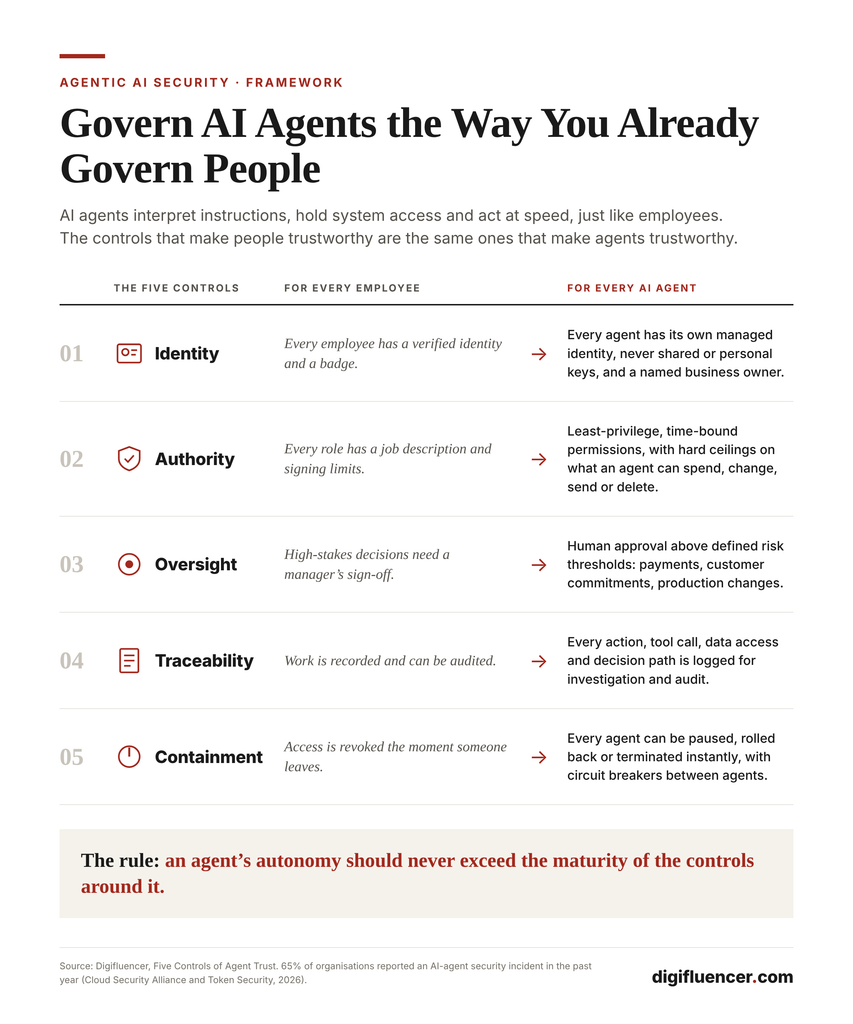
AI agents should meet the same standard. From that principle, we derive five controls of agent trust.
Leaders should apply to every agent the disciplines they already apply to every employee with system access.
1. Identity: every agent is someone. Each agent should have its own managed identity, never shared credentials or a developer’s personal keys, and be registered in a central inventory with a named business owner. If an organisation cannot say how many agents it runs and who is accountable for each, nothing else can be governed.
2. Authority: every agent has a job description. Agents should operate under least privilege, with permissions scoped to their task and limited in time. Just as a junior employee has signing limits, an agent should have explicit ceilings on what it can spend, change, send or delete.
3. Oversight: high-stakes decisions have a supervisor. Human approval should be required above defined risk thresholds: financial transactions over a set value, commitments to customers, changes to production systems. The thresholds can rise as an agent proves itself, as they would for a person.
4. Traceability: every action leaves a record. Each action, tool call, data access and decision path should be logged in a form that supports investigation and audit. Research cited by Kiteworks from the DTEX 2026 Insider Threat Report suggests only 19% of organisations treat AI agents as equivalent to human insiders, which means most are not monitoring them as they would a person with the same access.
5. Containment: every agent can be stopped. Agents must be able to be paused, rolled back or terminated immediately, and multi-agent systems need circuit breakers that stop failure from spreading. The ability to intervene is the precondition for granting autonomy at all.
None of these controls is exotic. Most organisations already have the underlying capabilities in identity management, access governance and security monitoring. What is missing is the decision to extend them to a new kind of worker.
Match Each Agent’s Autonomy to the Maturity of Its Controls
Not every agent needs the same level of control, any more than every employee needs the same level of supervision. An agent that drafts internal summaries carries different risk from one that issues refunds or changes infrastructure. The principle we recommend is simple: the autonomy granted to an agent should never exceed the maturity of the controls around it.
Exhibit 2: The Agentic Security Maturity Model
Most organisations operate at Stage 1 or 2. Any agent that can move money, change systems or commit to customers should run at Stage 3 or above.
| Stage 1: Experimental | Stage 2: Controlled | Stage 3: Governed | Stage 4: Trusted at scale | |
|---|---|---|---|---|
| Inventory | Unknown | Partial, team-maintained | Complete, centrally governed | Continuous discovery, including shadow agents |
| Identity and access | Shared or personal credentials | Dedicated identities, broad permissions | Least privilege, time-bound | Dynamic, context-aware authorisation |
| Human oversight | Informal | Manual review of outputs | Risk-tiered approval thresholds | Policy-driven, with exception escalation |
| Audit | Minimal | Basic logging | Action-level audit trails | Real-time behavioural monitoring |
| Containment | None | Manual shutdown | Defined kill switch and rollback | Automated circuit breakers |
| Governance | None | IT-led | Cross-functional with risk and legal | Board-reported, part of enterprise risk |
Source: Digifluencer.
Organisations that adopt this approach tend to find it accelerates deployment rather than slowing it. Once the controls exist, extending an agent’s authority becomes a governance decision with clear criteria, rather than a leap of faith.
The EU AI Act Deadlines That Make Agent Governance Urgent
Regulators are moving in parallel. Under the EU AI Act, transparency obligations, including informing people when they are interacting with AI, have applied since August 2, 2026. Following the Digital Omnibus on AI, which entered into force in July 2026, obligations for stand-alone high-risk systems, such as those used in employment, credit assessment and critical infrastructure, now apply from December 2, 2027.
For agents operating in those domains, the requirements for human oversight, logging, risk management and data governance map closely to the five controls described here. Organisations that build them now will be ready. Those that wait will be retrofitting controls onto agents already embedded in core processes.
Established frameworks provide a foundation: the NIST AI Risk Management Framework for governing AI risk, ISO/IEC 42001 for AI management systems and the OWASP Top 10 for Agentic Applications for agent-specific threats.
Six Questions Every Board Should Ask About Its AI Agents
Agentic AI is a board-level matter because it delegates authority. Directors do not need to understand how agents work. They need to know that management can answer six questions:
- How many AI agents operate in our organisation today, including those embedded in third-party software?
- What can our most powerful agent do without human approval, and who decided that?
- Does every agent have its own identity and a named business owner?
- Where are the thresholds for human approval, and how are they enforced?
- If an agent caused harm tomorrow, could we reconstruct exactly what it did and why?
- How quickly can we stop an agent, or every agent, if something goes wrong?
If the answers are uncertain, the organisation’s agents are operating with more autonomy than its governance can support.
The organisations that capture the value of agentic AI will not be the ones that deploy the most agents or move the fastest. They will be the ones that can extend autonomy with confidence, because they have built the controls that make agents trustworthy.
That trust is earned the same way it is earned with people: through clear identity, defined authority, appropriate oversight, accountability and the ability to intervene. Autonomy, for agents as for employees, should be earned.
Digifluencer helps organisations design, build and secure AI agents that can be trusted in production. Our AI engineering and cybersecurity teams inventory agent estates, implement identity and access controls, engineer human oversight and audit, and test agents against emerging threats. Request an agentic AI security assessment.
Sources
- Cloud Security Alliance and Token Security, “Autonomous but Not Controlled: AI Agent Incidents Now Common in Enterprises,” April 2026, as reported by Kiteworks. https://www.kiteworks.com/management-of-cybersecurity-risks/ai-agent-security-incidents-2026/
- Gravitee, “State of AI Agent Security 2026.” https://gravitee.io/state-of-ai-agent-security
- Palo Alto Networks, 2026 Identity Security Landscape report, as reported by Let’s Data Science, May 2026. https://letsdatascience.com/news/machine-identities-outnumber-human-identities-109-to-1-f38176a6
- IBM, Cost of a Data Breach Report 2026, as reported by eSecurity Planet, July 2026. https://www.esecurityplanet.com/cybersecurity/ibm-2026-cost-of-a-data-breach-report-key-findings/
- OWASP GenAI Security Project, “OWASP Top 10 for Agentic Applications for 2026,” December 2025. https://genai.owasp.org/resource/owasp-top-10-for-agentic-applications-for-2026
- National Law Review, “EU Digital Omnibus on AI Enters into Force.” https://natlawreview.com/article/eu-digital-omnibus-ai-enters-force
- NIST, “AI Risk Management Framework.” https://www.nist.gov/itl/ai-risk-management-framework
- ISO, “ISO/IEC 42001:2023.” https://www.iso.org/standard/81230.html